
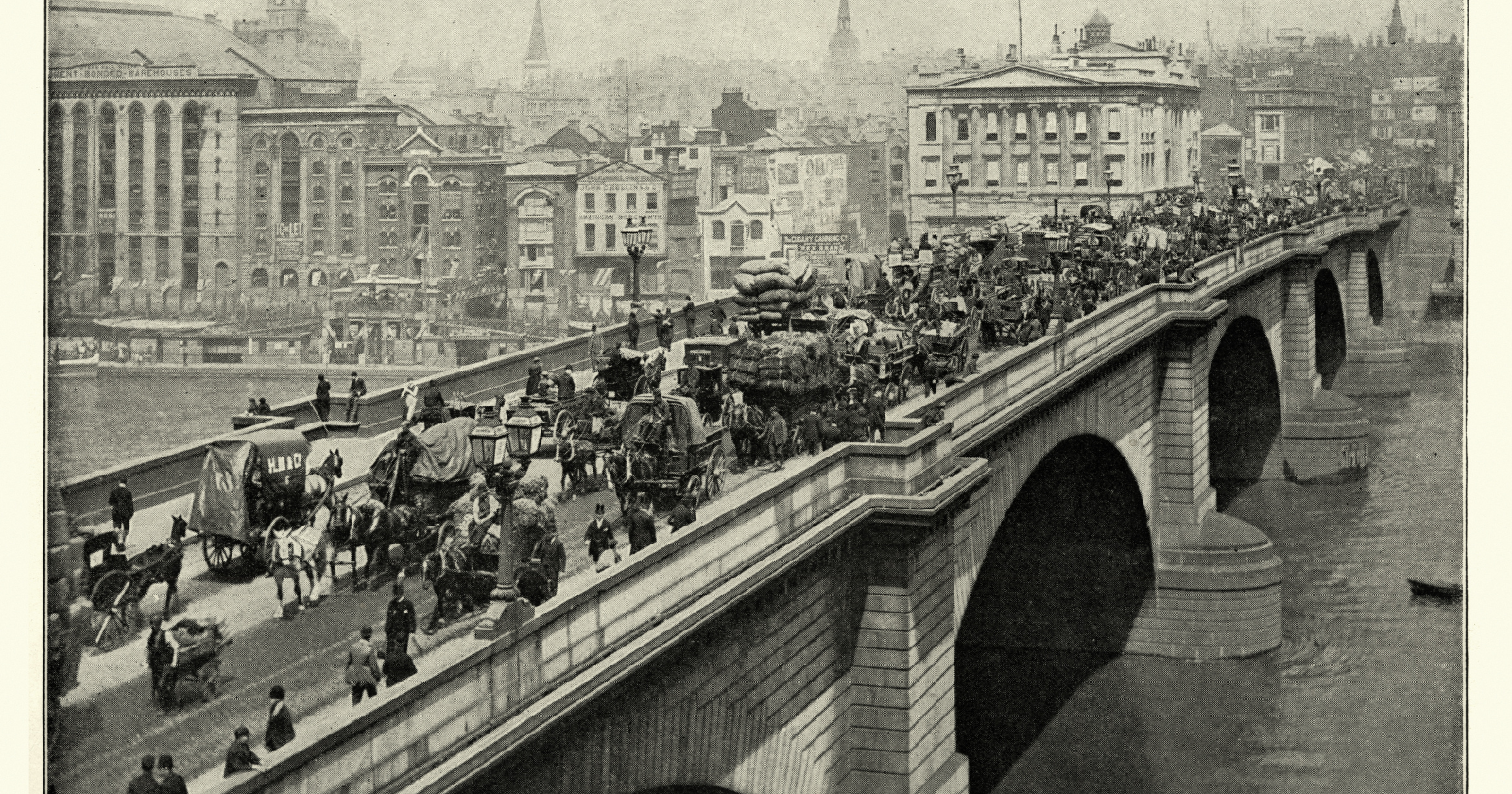
London Bridge spent 137 years carrying Londoners across the Thames. It now stands in the Arizona desert, over a channel of water that was dug so it would have something to cross.
The man who put it there made much of his money selling chainsaws and outboard motors.
Why the City of London put its bridge up for sale
By the early 1960s, the granite crossing designed by engineer John Rennie was settling into the riverbed. A feature on History.com puts the rate at roughly an inch every eight years, a pace that sounds harmless until it is combined with decades of motor traffic the bridge was never built to carry. It had come through strafing in the Blitz. Cars proved a slower and more patient enemy.
The City of London settled on a wider replacement, and the old bridge looked destined for the scrapheap. One councillor had a better idea, which was to sell it to the Americans. He took the pitch to a press conference in New York, presenting a fairly plain nineteenth-century bridge as the heir to two thousand years of London history, stretching back to the Romans.
How the price of a bridge was worked out
“We poured an awful lot of scotch trying to loosen them up.”
That was Robert McCulloch, describing the negotiations to the Chicago Tribune Magazine in a line History.com has preserved. His latest venture was Lake Havasu City, a planned town beside a reservoir on the Colorado River, and it had a marketing problem. Buying the land had been the easy part. Convincing people to settle in a remote and scorching stretch of desert was proving considerably harder.
Go Lake Havasu, the city’s visitor bureau, explains how he landed on a number. Dismantling the bridge was expected to cost about $1.2 million, so McCulloch doubled that and added $60,000, one thousand dollars for each year of his age. In April 1968, London accepted $2,460,000.
A stroke of bureaucratic luck followed. American import duty on prepared granite stood at 11 per cent, which by the reckoning of US Customs and Border Protection would have added about $270,600 to the bill. Customs officers instead declared the bridge an antique, since anything over a century old was exempt, and let it in duty-free. Guinness listed it as the largest antique ever sold.
A durable rumour holds that McCulloch thought he was buying Tower Bridge, the showy one with the towers a little way downstream. The visitor bureau is having none of it.
Shipping 10,000 tons of granite to the desert
How do you post a bridge? In numbered pieces, mostly. Before the demolition crews moved in, each of the 10,276 exterior granite blocks was marked with a number, per Go Lake Havasu, turning the old facing into an enormous flat-pack kit.
The first batch, 855 tons of stone, spent a month at sea on a voyage of about 10,000 miles through the Panama Canal to Long Beach, California, as documented by the customs agency. It docked on 4 July 1968, a slightly cheeky date for a slab of the British capital to land in America. Trucks hauled the blocks the final 300 miles inland. The same account notes that Americans were on something of a British shopping spree at the time: a seventeenth-century London church had been shipped to Missouri in 1966, and Long Beach had bought the ocean liner Queen Mary the following year.
Structurally speaking, the Arizona bridge is wearing a costume. As AARP’s retrospective on the move recounts, the granite was reassembled over a concrete core strong enough for modern traffic, and the whole thing went up on dry ground.
For a while, London Bridge crossed nothing at all.
Once the cladding was finished, crews dug a channel beneath it and let the lake flood in, cutting off a stretch of shoreline to create an island. The shipping, rebuilding and dredging came to $7 million, the tourism office says, and CBP adds that the rebuild strained McCulloch’s finances.
What the bridge did for Lake Havasu City
The rededication on 10 October 1971 came with skydivers, fireworks, hot air balloons and the Lord Mayor of London in full ceremonial robes, according to History.com. The banquet menu of lobster and roast beef copied the one laid on for King William IV when the bridge first opened in 1831. AARP puts the crowd at 25,000.
The gamble worked. Interest in buying land in the town climbed once the bridge opened, and Arizona Highways reports that McCulloch was said to have recouped every cent the project cost him. McCulloch Boulevard, named for the town’s founder, now carries traffic over the bridge. Lake Havasu City has grown to more than 50,000 residents, while the bureau counts hundreds of bats and thousands of swallows living in the bridge itself.
Go Lake Havasu bills the bridge as Arizona’s second most popular tourist attraction, beaten only by the Grand Canyon. That is heady company for a second-hand crossing from the Thames.
London, for its part, drew the line at one landmark. As reported by AARP, a group of San Diego investors offered to buy Big Ben in 1968, apparently inspired by McCulloch’s purchase. A city official wrote back to say the clock tower was not for sale.