
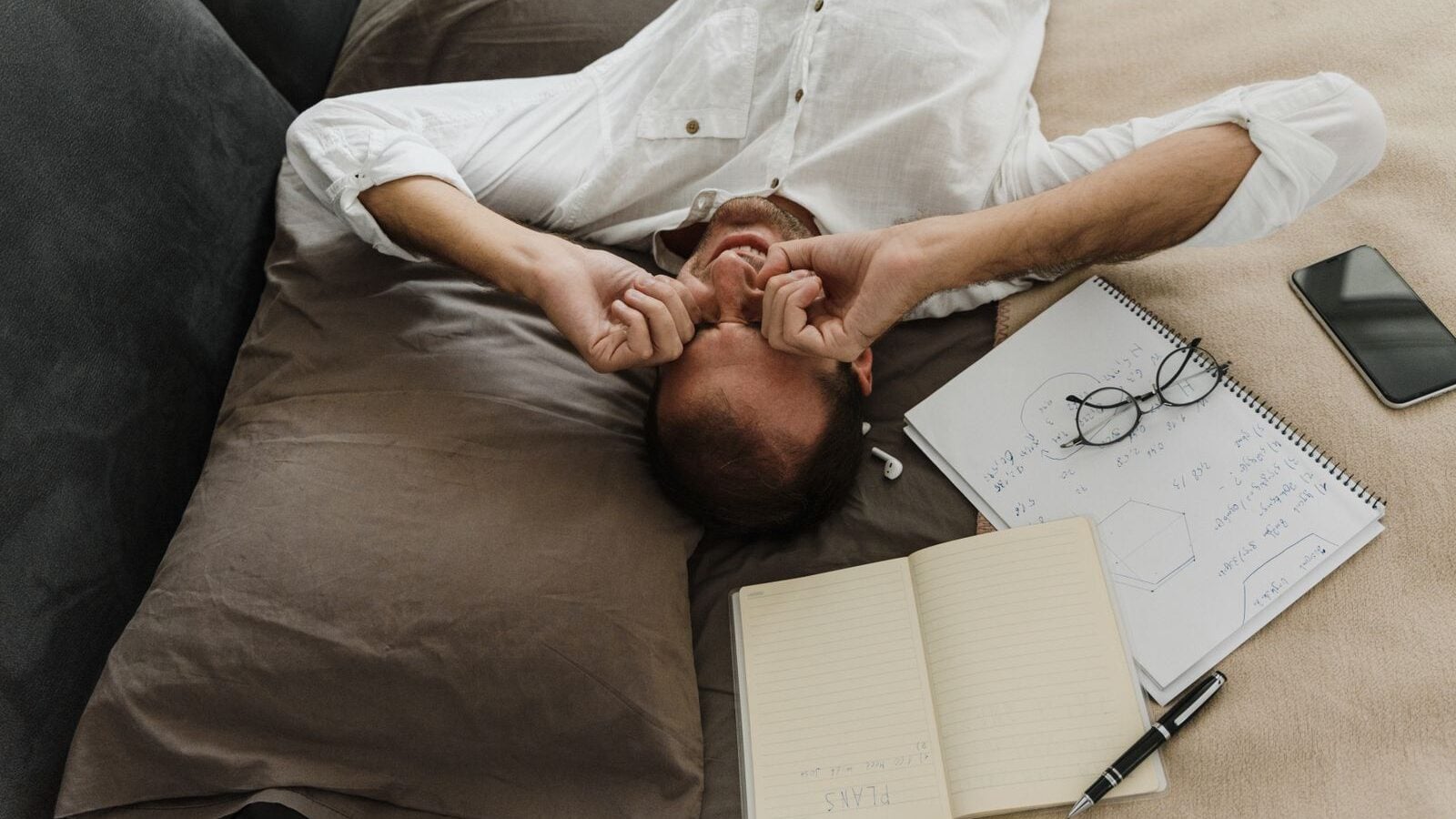
Emma Rao spent almost three years on what China calls the 996 schedule — nine in the morning to nine at night, six days a week — working for a multinational pharmaceutical company in Shanghai. By the time she got home, showered, and ate, midnight was closing in. She stayed up anyway. She surfed the internet, read the news, watched videos, and pushed sleep back further into the small hours. She knew it was hurting her. She did it anyway. In her own account to the BBC, she called it a revenge. A way to steal back time.
The word most people would reach for to describe Rao’s late nights is lazy. It is the wrong word. It is almost always the wrong word.
The evening habits that get labelled lazy — the endless scroll, the sixth episode, the delayed shower, the promise to start tomorrow — rarely belong to people who lack ambition. They belong to people who spent the day being someone else and want, for a few hours, to be themselves. That is a different problem. And it responds to different things.
Consider Marcus, a 34-year-old software engineer in Austin who finishes standups at six, closes his laptop at seven, and then sits on the couch with his phone until one in the morning. He is not resting. He is not planning tomorrow. He is not really enjoying what he is watching. He is running down the clock on a day that was not his, in a body that still has not decompressed. In the morning, when the alarm hits, he calls himself undisciplined. He is not. He is unmetabolized.
There is a name for what Rao and Marcus are doing. Researchers call it bedtime procrastination — voluntarily delaying sleep without any external reason to stay up. The pattern clusters around evening screen use and a general sense that daytime hours had not belonged to the person delaying sleep. The pattern crosses occupations. It is not about willpower. It is about ownership of time.
The revenge framing came from a Chinese phrase, bàofùxìng áoyè, which spread on social media after a 2020 post from journalist Daphne K Lee. She described it as people who don’t have much control over their daytime life refusing to sleep early to regain some sense of freedom during late-night hours. Note what she did not say. She did not say people who are weak. She did not say people who don’t want to succeed. The behavior is a response to a schedule that has been colonized, and the response happens to be self-defeating.
This is the first thing the lazy label misses. What looks like an evening habit is often a daytime injury.
The second thing it misses is that the evening is when almost everyone’s capacity to make good decisions is at its weakest. Decision-making degrades across a long day of choices. The person who scrolls at 11 p.m. is not the same person who chose the gym membership in January. Judging the eleven-o’clock version by the January version is a category error. And the January version, notably, is never around at eleven.
Consider Priya, a 41-year-old paediatric nurse in Manchester, who spends twelve hours making rapid, high-stakes decisions about other people’s children. By the time she gets home, the part of her that can weigh options and choose the harder path has been spent. She reheats something. She sits down. She opens an app. Three hours pass. If a productivity guru asked her why she didn’t use that time to study for her advanced certification, she would say she was tired. What she means is that she has nothing left to spend.
The scroll itself has a specific quality worth naming. Consumption without completion — activity with no ending built in — leaves people feeling worse about themselves than activities that close a loop. A walk ends when you get home. A book ends at the last page. A feed does not end. That is why an hour of it feels heavier than an hour of almost anything else, and why the person doing it looks, from the outside, like they are choosing to waste time.
They are not choosing. Choosing implies a live agent weighing alternatives. What is happening on the couch at eleven is closer to drift.
Where this drift comes from keeps landing on the same place. A 2025 study in Frontiers in Psychology on college students in China found that bedtime procrastination was mediated by self-control depletion and phone use, and that physical exercise earlier in the day was associated with less of it. This is one study on a specific population and not settled consensus, but it points in a direction other work has pointed for years: the person who cannot stop scrolling at midnight is often the person whose self-regulation reserves were spent by three in the afternoon.
What the lazy framing does, then, is take a depletion problem and diagnose it as a character problem. That misdiagnosis has consequences. If you believe the issue is character, you try to fix it with willpower — earlier alarms, harder rules, more shame. If you believe the issue is depletion, you fix it structurally, by changing what happens before the evening ever arrives.
The CEOs that Business Insider profiled in its Power Hours series are useful here, not because their lives are enviable but because their habits are unusually explicit about protecting the reserves. In interviews with 100 executives, some of the most consistent behaviors were about walling off the day so that the evening had somewhere to land. Carter Reum, the M13 cofounder, refuses to let his inbox be his to-do list. Bold Bean Co. CEO Amelia Christie-Miller uses an app called Opal to lock her out of email, Instagram, and LinkedIn after 9:30 p.m. Forvr Mood founder Jackie Aina stops answering emails around six or seven. Rebecca Minkoff schedules 30-minute blocks for email rather than checking it constantly.
What these people share is not more willpower than everyone else. It is the recognition that willpower runs out and the evening arrives regardless. They set the structure while they still have the capacity to set it. By the time the eleven-o’clock version of themselves shows up, the decision is already made.
This is where the lazy label collapses under its own weight. The people who look most disciplined in the evening are usually the ones who did the least discipline-work in the evening. They front-loaded it. They removed the choice. The person who scrolls until one is not losing a fair fight against the person who reads until ten. There was no fair fight. One of them arranged the day so the fight never had to happen.
Consider Daniel, a 52-year-old accountant in Cleveland who has been telling himself for six years he will start going to bed at ten. He has read three books on habits. He has downloaded four sleep apps. Every morning he resolves. Every evening he collapses onto the couch after making dinner, helping with homework, and answering the last work message at 8:47. By 9:30 the decision has already been made by a version of him that is running on fumes. He wakes up at six and calls himself weak. He is not weak. He is asking a depleted person to do the job of a rested one.
There is one more layer worth naming, because it is the one people rarely say out loud. Some evening drift is not about work at all. It is about the absence of anything the person actually wants to move toward. For some people, an empty evening is not a rest opportunity but an exposure. The scroll is not filling time. It is filling a room that would otherwise be quiet enough to hear something the person has been avoiding.
Naming that is not a diagnosis. It is a description of a common pattern. The person who cannot sit with the quiet is not lazy. They are managing something. The management is loud and expensive and mostly invisible to them.
Which brings the whole frame back around. The habits people list under lazy evenings — the phone in bed, the delayed shower, the fourth drink, the promise about tomorrow, the show they aren’t really watching — are almost never the cause of an unproductive life. They are the receipts. They show up after the day has already spent the person.
People who reliably build the kind of life that others describe as disciplined are not fighting harder at eleven. They are fighting differently at nine in the morning, at two in the afternoon, at the moment they decide whether to say yes to another meeting, at the moment they choose whether to answer a message or let it wait. By the time the evening arrives, there is very little for their willpower to do. The couch is safe because the day was.
The label does damage in the opposite direction, too. Calling yourself lazy for an evening you couldn’t control is a way of accepting the arrangement that produced it. It puts the failure inside you, where it can be scolded, instead of inside the schedule, where it might have to be changed.
Emma Rao eventually left the 996 job. She swapped it for something slightly less demanding. She told the BBC that the late-night habit stayed with her anyway — that it had become its own kind of loyalty to a self she had built in the small hours. That detail is the honest ending. The habits do not always disappear when the pressure lifts. But they were never who she was. They were what the pressure did.
The person on the couch at midnight is not the problem to be solved. They are the messenger. And the message is almost always about the fourteen hours that came before them.