
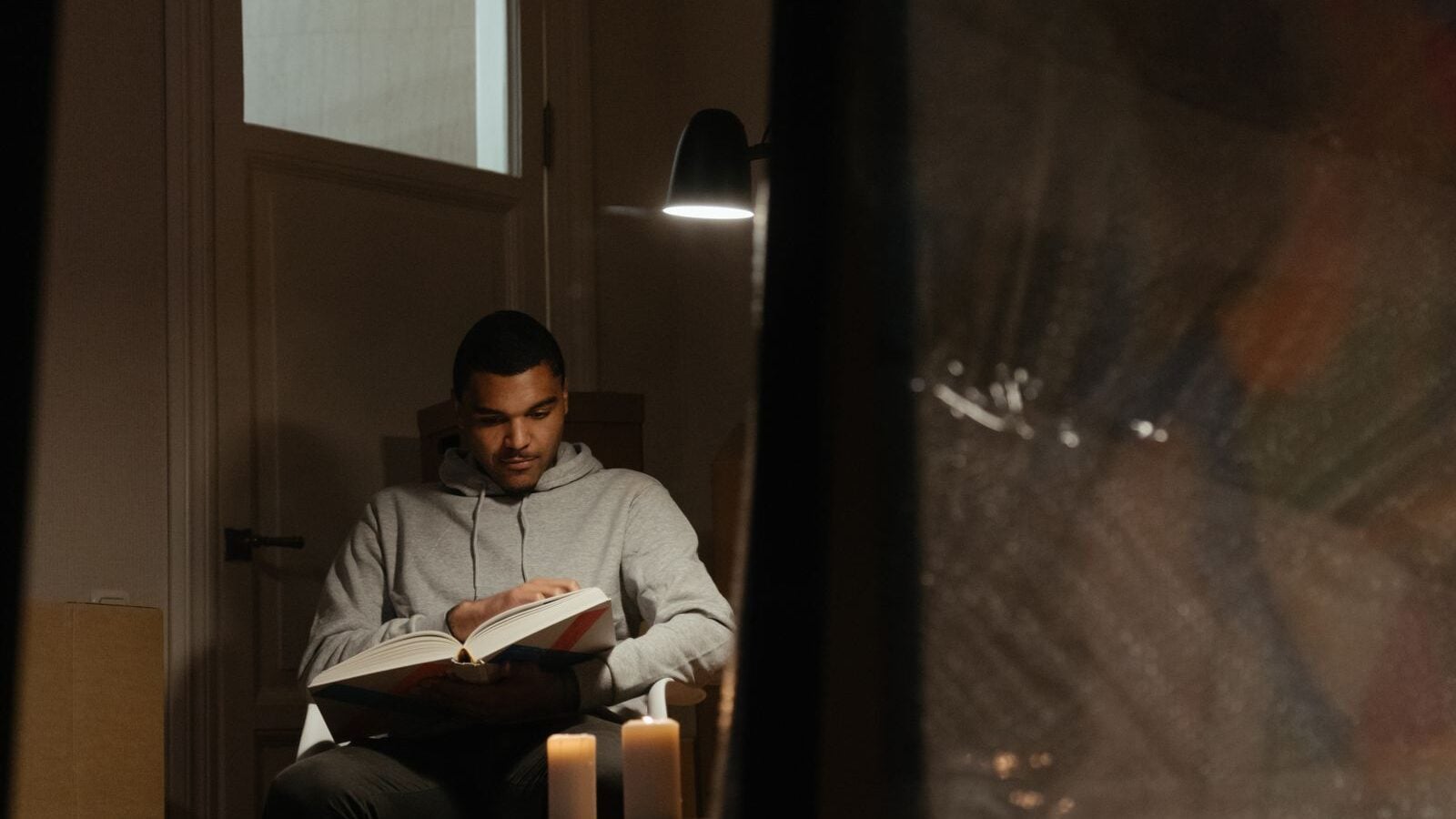
The loneliness that comes at 9pm has a specific texture. It isn’t the loneliness of an empty room. It’s the loneliness of a room full of noise — a phone lit up with notifications, a television playing something no one is watching, a laptop open to work that ended hours ago. The person in the room is technically stimulated. They are also, by every meaningful measure, alone with themselves and not enjoying the company.
This is a familiar shape for a lot of evenings. Someone comes home, eats something reheated or ordered in, and settles into the couch with a phone already in hand. An hour disappears, then two, then three, into a scroll that’s hard to reconstruct afterward. By bedtime there’s a specific kind of tiredness that doesn’t feel like rest — wired and hollow at the same time. The explanation people reach for is usually one of two stories: they were too tired to make other plans, or they just need to get more motivated. Neither explanation tends to hold up under real scrutiny.
What’s actually happening in those hours is not resting. It is not connecting. It is a third thing — a kind of low-grade emotional management that leaves people feeling worse than when they started.
There is a pattern here that shows up in a lot of ordinary lives. The evening is supposed to be the recovery window. For many people, it has become the part of the day where the loneliness compounds and the motivation for tomorrow quietly leaks out.
This is a reading of behavior patterns and the available research, not medical or psychological advice. What follows is not a treatment plan. It is an attempt to describe what actually seems to be happening in the hours between dinner and sleep.
A study of medical college students published in Frontiers in Psychology found that both perceived stress and negative emotions were positively correlated with smartphone overuse, and that negative emotions helped explain the statistical link between higher stress and heavier phone use. It’s one study, in one specific population, and it doesn’t settle which direction causation runs. But the pattern it describes will be recognizable to anyone who has ever finished a two-hour scroll feeling worse than when they started.
Sleep timing appears to matter too, though the picture is more tangled than “night owls are doomed” headlines suggest. A 2023 review in World Psychiatry, the journal of the World Psychiatric Association, found that a later chronotype is consistently associated with a range of mental health outcomes — though the authors were careful to frame it as a transdiagnostic pattern, not a fully explained one. Researchers increasingly suspect this has less to do with the clock itself and more to do with the behaviors that tend to cluster around late hours — alcohol, junk food, the kind of decisions people make when their capacity for making decisions has already been spent.
A lot of evenings that get described as an exhausting routine of just trying to make it to bed — show after show, scrolling until the eyes hurt — aren’t really about tiredness. They’re closer to what psychologists call decision fatigue: the depleted state in which a brain that has made choices all day starts defaulting to whatever requires the least effort. In the evening, the least effort is the screen. It’s worth noting the concept has had a bumpy road in psychology — some of the underlying willpower-as-a-limited-resource research has struggled to replicate — but the everyday experience of running low on the will to choose anything harder than a couch and a feed is one plenty of people recognize regardless of how the lab data eventually shakes out.
The loneliness part is worth pausing on. It is easy to describe evening loneliness as a social problem — not enough friends, not enough plans, not enough calls. Sometimes that is accurate. But there is another version of it that lives inside people with plenty of social contact during the day. It shows up when the external structure drops away and the person is left with themselves, and the self they meet at 9pm is not a self they know how to spend time with.
Some adults report difficulty relaxing on days off because stillness itself can feel uncomfortable. Evenings can carry the same charge. If quiet was historically the moment something went wrong, or the moment a difficult feeling arrived unbidden, then the adult evening becomes a small nightly problem to be solved with noise.
The noise works, in the short term. That is the trap. The scroll does dull the edge. The show does distract from the thought. The wine does soften the day. None of these things are villainous on their own. What makes them corrosive is the accumulation — the way three hours of them in a row leaves a person less able to sleep, less able to want anything in particular the next morning, and less able to name what is actually missing.
The people who describe climbing out of this pattern rarely point to anything dramatic. They’re not lonely in any obvious way — they have colleagues, relationships, people who call. What they describe instead is a kind of dull static in the evening hours that doesn’t lift no matter how much screen time they give it. Going to bed at midnight feeling exactly as depleted as they did at seven.
What tends to change is small. A walk after dinner — not for fitness, just to be outside without a screen. The phone left on a shelf by the door instead of in a pocket. Half an hour with an actual book instead of a feed. Fewer drinks on weeknights, less because of any diagnosed problem and more because even one glass tends to make the scroll feel like the easier option.
None of this is revolutionary. What’s more interesting is what it tends to do to a person’s sense of themselves. Within a few weeks, people who make these changes often describe the static lifting — a return of the ordinary desire to see a friend, start a project, plan something for the weekend. The motivation wasn’t broken. It was buried under hours of low-grade stimulation that felt like rest and wasn’t.
The exercise piece has real support behind it. A 2018 meta-analysis of nearly 50 prospective cohort studies in the American Journal of Psychiatry found that people with higher levels of physical activity had meaningfully lower odds of developing depression than people with low activity levels, across age groups and geographic regions. The finding supports the ordinary intuition that moving the body in the evening — even modestly, even briefly — appears to do something for the mind that scrolling does not.
Sleep is the other lever, and here too the research lines up with what people report. A study drawing on nearly a thousand participants from the Human Connectome Project found that poor-quality and shortened sleep tracked with higher negative affect and lower life satisfaction, even in a healthy, non-clinical sample. The mechanism it points to — that skimping on sleep makes everything harder, including the capacity to feel motivated or connected — is consistent with what people report about their own evenings once they start protecting sleep instead of sacrificing it.
The habits that seem to help are almost boring in their simplicity. A walk. A book. A conversation with one person, in real time, even briefly. A screen-free half hour before bed. A consistent sleep window. Something like a small ritual to mark the end of the workday — putting the laptop away in a drawer, changing clothes, making a proper meal instead of grazing.
What is striking is not that these things work. It is how much resistance people put up to trying them. The hardest part, by most accounts, isn’t the walk or the book — it’s the moment of putting the phone down. That moment can register as a small panic, an unfamiliar blank space with nothing obvious to fill it. Getting through several evenings of that discomfort, before it starts to ease, seems to be a normal part of the process rather than a sign it isn’t working.
This is worth noticing. The reason evening habits are so hard to change is not that people are lazy or undisciplined. It is that the current habits are doing a job. They are managing something. And when you take them away, the thing they were managing shows up.
Sometimes that thing is grief, or an unmade decision, or a relationship that isn’t working, or a career that has quietly stopped fitting. Sometimes it is just the ordinary weight of being a person at the end of a long day. Either way, the scroll was serving as a wall between the person and whatever was behind the wall. Taking the wall down means meeting what was behind it.
This is where the loneliness piece comes back into focus. What a lot of people describe as loneliness in the evening is not, strictly, the absence of other people. It is the absence of themselves. They have spent the day performing versions of themselves for colleagues, clients, family members, and by evening they have very little left over for their own company. The scroll fills that gap without ever closing it.
The habits that help are the ones that give the person back to themselves in small doses. A walk is a conversation with your own thoughts. A book is a slower kind of company. Sleep is the body’s way of clearing the residue. None of these require anyone else to show up. They require the person to show up for themselves, briefly, and to notice that they are still there.
Sometimes the shift arrives by accident rather than intention — a phone that breaks and can’t be replaced for a few days, a trip somewhere without reliable signal, a stretch of days with a device left behind on purpose. People who describe these forced breaks often say the same surprising thing afterward: those were the first evenings in years where they felt genuinely present in their own lives. Dinner made slowly instead of eaten over a screen. An actual phone call instead of a scroll. Sleep that came easily and lasted. When ordinary access returns, many say they keep at least some of the change — and that the strange part was realizing how much of their sense of being lonely had been produced by the very thing they’d been using to feel less alone.
There is a version of this insight that gets sold as a productivity hack or a wellness routine. That framing misses the point. The evening is not a problem to be optimized. It is the part of the day where a person either meets themselves or avoids themselves, and the accumulated weight of that choice, made every night for months or years, shapes how motivated and connected they feel in every other hour.
The people who describe having climbed out of that particular hole tend to say the same thing in different words. They didn’t fix their loneliness by finding more people. They didn’t fix their motivation by finding more discipline. They stopped using the evening to escape the day, and started using it, in small quiet ways, to end the day properly. The rest followed on its own.