

The habit gets described as intuition. It might be more accurate to describe it as an old reflex still running.
There is a particular way some people enter a room. Within a few seconds they have registered who is angry with whom, which conversation is strained, who arrived already unhappy, where the door is. They do not decide to do this and usually cannot say how they did it. Their friends call them perceptive. Their managers send them into the difficult meetings.
What is happening is not mystical, and it is not quite social awareness in the way that phrase is usually meant. It is something older, quieter, and more physical: a body that learned very early to read the emotional weather of a room the way sailors read the sky.
The habit tends to get flattered. Sensitivity, empathy, emotional intelligence — the culture has a whole shelf of admiring words for people who walk into a space and immediately know who is upset with whom. Some of those words fit. Some of them cover something the person themselves would rather not look at.
The scanning came before the vocabulary. That is the part that gets missed.
Children in unpredictable households learn to read faces before they learn to read sentences. A parent’s jaw tightening, a footfall on the stairs, the particular quality of silence at the dinner table on a bad night — these become the first language. The child does not decide to study them. The body studies them, because the body has correctly identified them as information about whether the next hour will be safe.
Building on polyvagal theory, the underlying process is called neuroception — the continuous, non-conscious scanning the nervous system performs to assess whether an environment is safe or dangerous. In a summary of polyvagal theory published on Mad in America, the writer describes neuroception as the way a person continuously and non-consciously scans the environment from the perspectives of safety and threat. Most people do this. Some people do it at a volume the rest of the world cannot hear.
A note before going further. This is a piece about a common behavior pattern, not a diagnosis. Polyvagal theory is one influential framework among several, and it remains debated within the research community. What follows is a reading of that framework and how it maps onto ordinary experience, not medical or psychological advice.

In practice it looks unremarkable. Someone walks into a staff room and knows, within a few seconds, that a difficult conversation has already happened there that morning. They could not tell you how. Something about the arrangement of the cups, the pitch of the talk, whether two colleagues are making eye contact. It reads, from the outside, as a knack.
The scanning does not turn off when the environment changes. That is the piece the admiring vocabulary tends to skip. A nervous system that learned to read moods before it learned to read words does not learn, later, that the meeting is not the kitchen and the friend is not the parent. It reads every room with the same instrument.
Which is why the pattern often shows up alongside its cousins: the mental replay of conversations for hours afterward, the internal audit of every facial expression, the sense of being tired after gatherings that other people found pleasant. DMNews has examined how post-event conversational replay works for people trained to catch small shifts in tone, and the way the mind will keep reviewing footage for a threat long after the event is over. The scanner in the doorway and the reviewer at 2 a.m. are the same instrument, running at different hours.
Body-based approaches to trauma rest on the argument that the body and the mind are not separate systems being addressed by the same event but a single system responding to it. The scanning is not a thought. It is a physical event happening in a body that made a reasonable decision, years ago, that reading the room quickly was worth the cost of reading it constantly.
The cost part is what tends to go unspoken.
It shows up in small, specific preferences that rarely get explained out loud. Not sitting with your back to the door in a restaurant. Not fully settling at a party until every unpredictable person in it has been located. Coming home from three hours of something enjoyable feeling as though a shift has ended. From the outside this reads as being socially gifted. From the inside it is closer to a security detail sweeping the perimeter — not enjoying the room, confirming it.
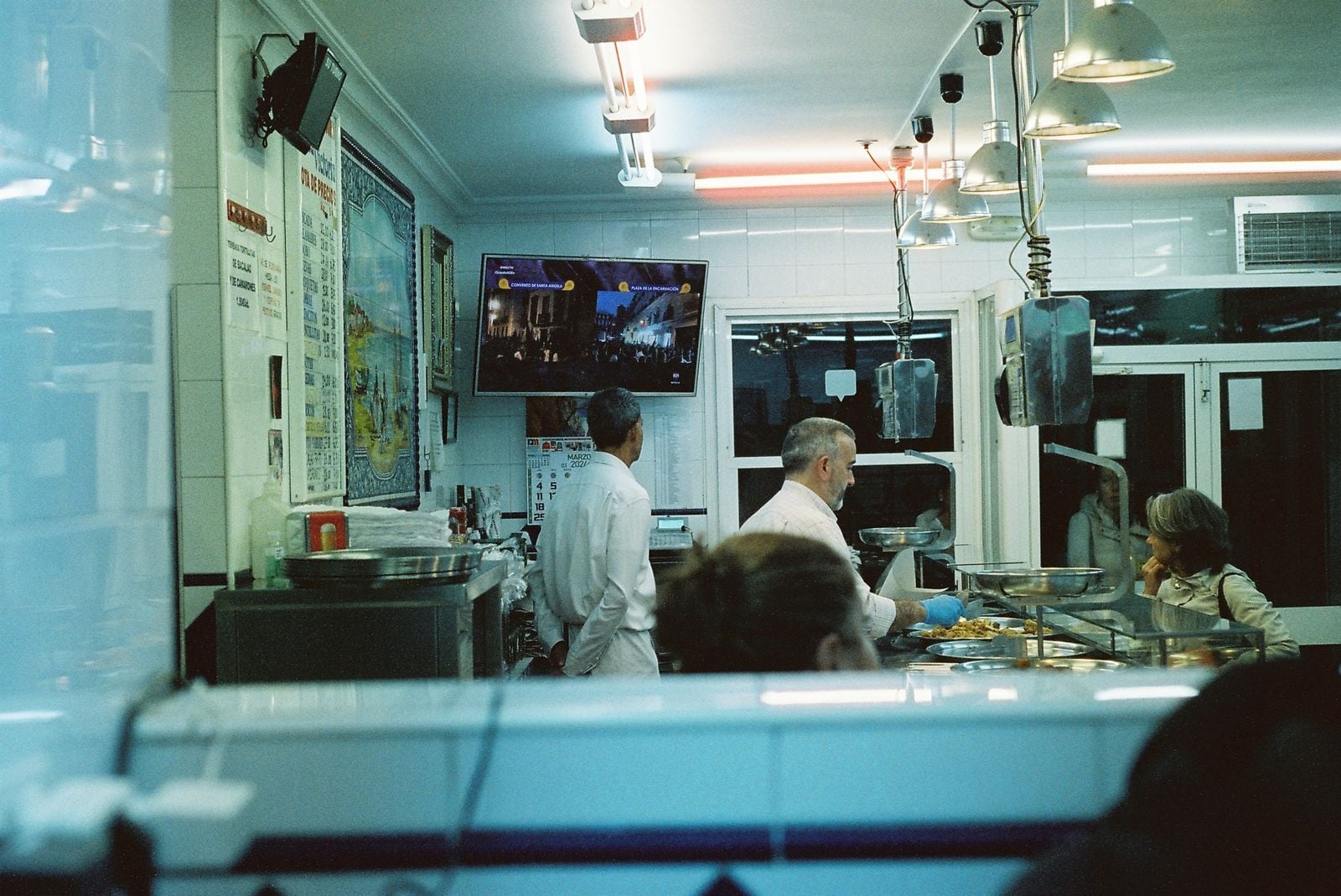
This is where the flattering language becomes a problem. Being told you are perceptive is pleasant. It is also, sometimes, the thing that keeps a person from noticing that the perceptiveness is not free — that it runs on a background process that never rests, and that the same faculty that makes them excellent at reading a boardroom makes them unable to fully arrive in their own living room. The gift and the tax are the same faculty. This is a way of describing a common pattern, not a clinical claim about any individual.
Polyvagal theory offers one useful lens here. In a Psychology Today piece by MaryCatherine McDonald, PhD, defending the theory against recent critiques, the model is described as a hierarchy of autonomic states: a ventral vagal state supporting social engagement and felt safety, sympathetic activation driving fight-or-flight, and a dorsal vagal state associated with shutdown. A person whose early environment reliably provided cues of threat will develop a body that is very good at detecting those cues and less good at settling into what the model calls social engagement. The scanning, in that framing, is the price of admission to a room the body does not yet trust.
There is a version of this pattern the culture calls social awareness and a version it calls hypervigilance, and the difference between them is often invisible to the person doing it. Both involve reading rooms. Both involve noticing what others miss. The first tends to come with a body that can put the instrument down when the room is safe. The second tends to come with a body that cannot remember how.
Clinicians working with trauma survivors have explored how polyvagal theory can guide interventions. In a lecture description at the School of Visual Arts for a talk by art therapist Joshua B. Brancheau, the autonomic nervous system is described as the foundation of our adaptive responses to trauma — a phrasing that quietly does a lot of work. Adaptive. The scanning was adaptive. It made sense. It kept a child out of the worst of it. The question is not whether it worked. The question is what it costs to keep running an adaptation whose original environment no longer exists.
There is a reason this is so hard to see from the inside. When a pattern arrives early enough, it does not present as a coping strategy. It presents as personality. The person does not experience the monitoring as work; they experience it as who they are. It is also one of the reasons the pattern can look, from the outside, a lot like being a particular kind of quiet or self-contained person — the reserve is not preference, it is capacity management.
The people who developed this way of walking into rooms are often the ones others describe as the calm one: the sibling who kept the peace, the friend who defused arguments, the employee who could talk down a difficult client. That role is genuinely valuable. It also tends to be paid for later, in the body of the person who performed it.
What is worth understanding, and what the culture of self-help sometimes gets wrong, is that recognizing the pattern is not the same as being asked to give it up. The scanning is a real skill. People who read rooms this way do catch the colleague who is about to quit, the student who is struggling, the shift in a ward or a meeting that nobody else has clocked yet. The instrument is real. The information it produces is real.
The recognition is smaller and more specific. It is the recognition that the scanning is not neutral, that it is not free, and that it did not come from nowhere. It came from a specific place, at a specific time, in response to a specific environment. Which means it is not, actually, a description of who the person is. It is a description of what the person’s body learned to do in a room they no longer live in.
That distinction matters because it changes what the tiredness means. The exhaustion after the dinner party is not evidence of being socially defective. It is evidence of having done a substantial amount of unpaid work at the dinner party. The reluctance to be the last one to leave a room is not antisocial. It is the reasonable preference of a nervous system that has been on shift the whole time.
None of this requires a clinical label. It does not require deciding that the childhood was traumatic in some categorical sense, or that the parents were villains, or that the person is broken. Many people who walk into rooms this way grew up in homes that outsiders would have described as normal, or even happy. The environment did not have to be extreme for a small body to decide that reading the weather was a useful skill. It only had to be unpredictable enough, often enough, that predicting it became worth the cost.
The quiet part, the part the flattering vocabulary skips, is this. A person who has been reading rooms since before they could read words is often not, in any full sense, in the room. They are watching it. Watching is not the same as being present, and being valued for the watching can make it very difficult to notice the difference.
There is nothing to fix in the noticing itself. There is only, at some point, the small honest recognition that the doorway scan is not a personality trait, that the tiredness afterward is not a character flaw, and that a nervous system trained in a difficult room can be told, gently and repeatedly and by the person themselves, that this room is not that one.
Most people who do this have never been told they are allowed to stop.