
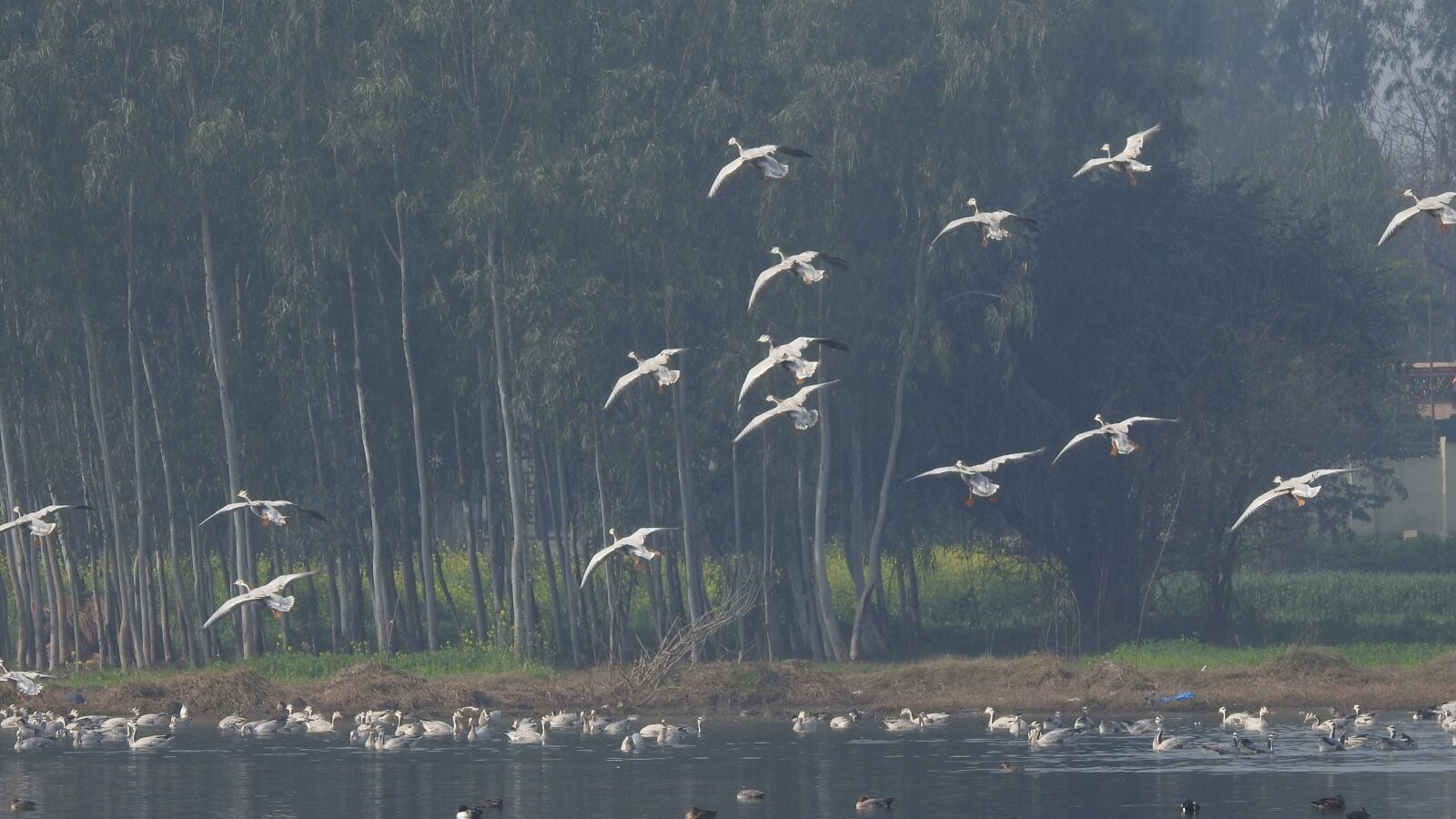
On 11 September 2026, BirdLife International launched its State of the World’s Birds report at the Global Flyways Summit in Nairobi, Kenya, co-hosted by Nature Kenya. It is the first edition of the flagship assessment devoted entirely to migratory birds and the flyways they depend on, and its headline number is blunt: 45% of migratory bird species are in decline. One in nine is threatened with extinction.
The figure that explains the first one sits a little deeper in the report. Only around 9% of migratory bird species have adequate protection across their full annual cycle, compared with 45% of non-migratory species. The gap is not a measure of how much anyone cares about migratory birds. It is a measure of how hard it is to protect an animal that spends its year inside several different jurisdictions, each with its own laws, budgets, and priorities.
What a 45% decline actually describes
Declines of this kind are rarely caused by one thing. BirdLife attributes the pressure overwhelmingly to human activity, listing invasive alien species, agricultural expansion and intensification, climate change, and unsustainable hunting and trapping. Those drivers operate at different points along a route. A bird can breed successfully in a protected northern landscape, then meet drained wetlands at a stopover, then meet trapping pressure on a coastline thousands of kilometers further south. The cumulative effect registers as a population decline without any single site being obviously responsible.
Seabirds and shorebirds are among the most threatened groups in the assessment, and species dependent on marine, forest, and coastal wetland habitats are faring poorly. That pattern is consistent with the mechanics of migration. Coastal wetlands in particular function as refueling points, and they are also some of the most heavily converted land on earth, squeezed between development, aquaculture, and rising seas.
The report’s cautionary case is the Slender-billed Curlew, confirmed extinct in 2025. It was last recorded at a Moroccan lagoon in February 1995. BirdLife frames it as the first global bird extinction in mainland Eurasia and Africa in recent centuries, and notes that six other migratory species have been confirmed or suspected lost over the last 150 years. The curlew is instructive less because it was rare than because it was watched. Observers across multiple countries knew the species was in trouble. Thirty years passed between the last sighting and the formal confirmation, and no single national conservation program had authority over the full range in which it disappeared.
Why flyway protection is a different problem from park protection
The 9% figure deserves to be read carefully. It does not mean that only 9% of migratory birds encounter a protected area. Many encounter several. It means that across the full annual cycle, breeding grounds, stopovers, and wintering areas together, only about 9% are adequately covered. Protection that is strong in one season and absent in another does not average out into partial safety. A missing link in a chain of sites behaves like a missing link in a chain.
This is where the contrast with non-migratory species becomes analytically useful rather than merely striking. A resident species can be secured by a well-managed reserve when the habitat it needs fits inside that boundary. The conventional conservation toolkit, national parks, protected area targets, domestic legislation, is better suited to that geometry. Migratory species do not fit it as neatly. They require agreement between countries with different capacities and different incentives, and they require that agreement to hold at every link simultaneously.
The report’s site-level analysis points the same direction. Mongabay, citing the report, notes that an assessment of 1,099 Key Biodiversity Areas important for migratory birds found over half in poor or very poor condition. These are the places that have already been identified as mattering. Identification is not management.
What Nairobi produced, and what it did not
The summit produced the Nairobi Flyways Declaration, signed by governments, scientists, NGOs, conservationists, and financial institutions, committing to cooperation at flyway scale. Alongside it, BirdLife points to more than $6 billion in conservation finance being mobilised by development banks since 2021. The Asian Development Bank is mobilising $3 billion over the next decade for at least 50 priority wetlands along the East Asian-Australasian Flyway. CAF, the Development Bank of Latin America and the Caribbean, is mobilising $3 to 5 billion through 2050 for more than 30 landscapes and seascapes. The World Bank and BirdLife are mobilising several billion across Africa, Europe, and Asia.
Those are mobilisation and commitment figures, not money already spent, and not a single check written in Nairobi. The distinction matters because the gap between announced finance and delivered site management is where those commitments will ultimately be tested. A declaration signed by governments and institutions is a coordination instrument. Whether it becomes durable protection depends on what happens at wetlands that are, right now, being drained.
There is evidence the approach can work when it is sustained. A peer-reviewed study of the Egyptian Vulture found that flyway-scale conservation helped halt the decline of the Balkan breeding population. That is one documented case, achieved across borders over years, and it is worth reading as proof of method rather than proof of trend. Nothing in the report suggests a global rebound.
What the Nairobi assessment establishes is narrower and more durable than a crisis headline. Conservation has been organized around places that hold still. Nearly half of migratory species are declining, roughly 9% are covered across their whole year, and the stated next step is broader implementation at flyway scale. That work is already underway in some regions, but the report makes clear that it remains far from complete.