
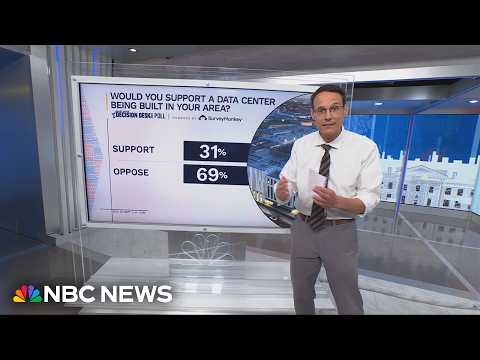
On the September 6, 2026 edition of Meet the Press, Kristen Welker handed the segment to NBC News chief data analyst Steve Kornacki, who brought new NBC News Decision Desk polling on artificial intelligence and data-center construction to the big board. The transcript records the handoff plainly enough. What is worth noticing is the form the segment took rather than the topic it covered.
Kornacki did not treat server farms as an infrastructure question requiring an explainer about load growth, interconnection queues, or evaporative cooling. He treated them as voting behavior. The board is a map of counties and districts, and once a subject arrives on that map it stops being a thing that gets built and starts being a thing that gets tallied. That conversion is the story here.
NBC’s accompanying politics reporting on voter opposition to data centers in key midterm races fills in the terrain the board was drawing on. The polling, per the Decision Desk framing presented on air, points in a direction rather than delivering a single headline percentage worth memorizing. Opposition is present. It is not evenly distributed. It appears to matter more where construction is proximate than where it is abstract.
What changes when infrastructure becomes a map object
There is a genre of television segment about energy and technology that starts with a diagram. Someone explains that a hyperscale facility draws a certain amount of power, that the power has to come from somewhere, that the somewhere is usually a grid that was not planned around it, and that ratepayers in the surrounding service territory may notice this on a monthly statement. That segment is useful. It is also not the segment that aired.
Kornacki’s version starts from the opposite end. It assumes the facility exists as a fact in someone’s county and asks what that fact does to their politics. The unit of analysis is not the megawatt. It is the voter who lives within sight of the transmission line.
This matters because the two framings produce different questions. The infrastructure framing asks whether the buildout is necessary, who pays for the upgrades, and how quickly permitting moves. The electoral framing asks whether opposition is durable, whether it crosses party lines, whether it concentrates in competitive districts, and whether any candidate has figured out how to speak to it. A big board cannot answer the first set. It is built for the second.
The craft choice is defensible. Kornacki’s job title is chief data analyst, and the Decision Desk exists to read electorates. But the choice carries a cost that is easy to miss while watching counties fill in with color. When a genuinely technical dispute about grid cost allocation gets rendered as a swing-district phenomenon, the technical dispute does not disappear. It simply becomes invisible on screen while remaining the actual driver of what people are upset about.
Here is the board package as it aired:
Two questions that look like one
The polling appears to hold two related items alongside each other: general attitudes toward artificial intelligence, and specific attitudes toward data-center construction nearby. On a map they can read as a single sentiment. They are not.
Worry about AI is a national mood question. It attaches to job displacement, to synthetic media, to a general sense that something large is happening without much public consent. It does not require a facility anywhere near you. Someone in a district with no construction at all can register high concern.
Opposition to a local data center is a siting question, and siting questions behave differently. They are shaped by traffic during construction, by water allocation in places where water is contested, by property values, by noise, by what the county commission promised about tax abatements, and by whether the electricity bill moved. These are the classic ingredients of local land-use fights, and they have historically been indifferent to national partisan alignment. People who agree on very little have combined to oppose a transmission corridor or a landfill.
The interesting analytical possibility, and the one the board gestures at without resolving, is that these two currents are converging. National unease about AI may be giving local siting opposition a vocabulary it did not previously have, and local siting fights may be giving national AI unease a concrete target. That would be a real development. It would also be hard to prove from a single cross-section of polling, and the honest version of the segment does not claim to have proved it.
On partisan structure, restraint is warranted. Whatever splits the Decision Desk found are the Decision Desk’s to report, and reading them as a stable feature of the electorate five months from now would be overreach.
What a board can and cannot carry
A Decision Desk board is excellent at one thing: showing where a sentiment is concentrated relative to where elections are close. That overlay is genuinely informative. If opposition clusters in districts that are within a few points, the issue has electoral weight regardless of whether it has national salience.
What the board cannot carry is causation about utility bills. Ratepayer impact depends on how a state’s public utility commission allocates costs between large load customers and residential ones, on whether special tariffs were negotiated, and on generation mix. Those vary by jurisdiction in ways no national map resolves. A county can be angry about a facility and have a bill that barely moved. Another county can be quiet and be paying for a substation upgrade.
The board also cannot tell you whether this holds. Local infrastructure anger is often intense and short-lived, peaking during construction and fading once the site is operational and the promised tax revenue arrives. Whether November 2026 catches this issue on the upslope or after the peak is not a question polling in September answers.
None of which is a criticism of the segment. It is a description of its boundaries.
The story Kornacki told on that board is about voters. It is about a constituency that has found something to be against, in places where being against something can change a seat. The cooling towers are the occasion. They are not the subject.