
To learn more about our editorial approach, explore The Direct Message methodology.
Around the year 2000, a doctoral student at the University of Copenhagen was having a frustrating time.
Eske Willerslev couldn’t get access to the small number of fossils that might contain traces of ancient DNA — there were precious few to go around, and he was an unknown in the field. Rather than wait, he started thinking differently. If DNA could persist in animal droppings, he reasoned, it might survive in soil too. In sediment. In the layers of ground that ancient humans walked across, camped on, and died in. His professors were skeptical. History turned out to be far more generous.
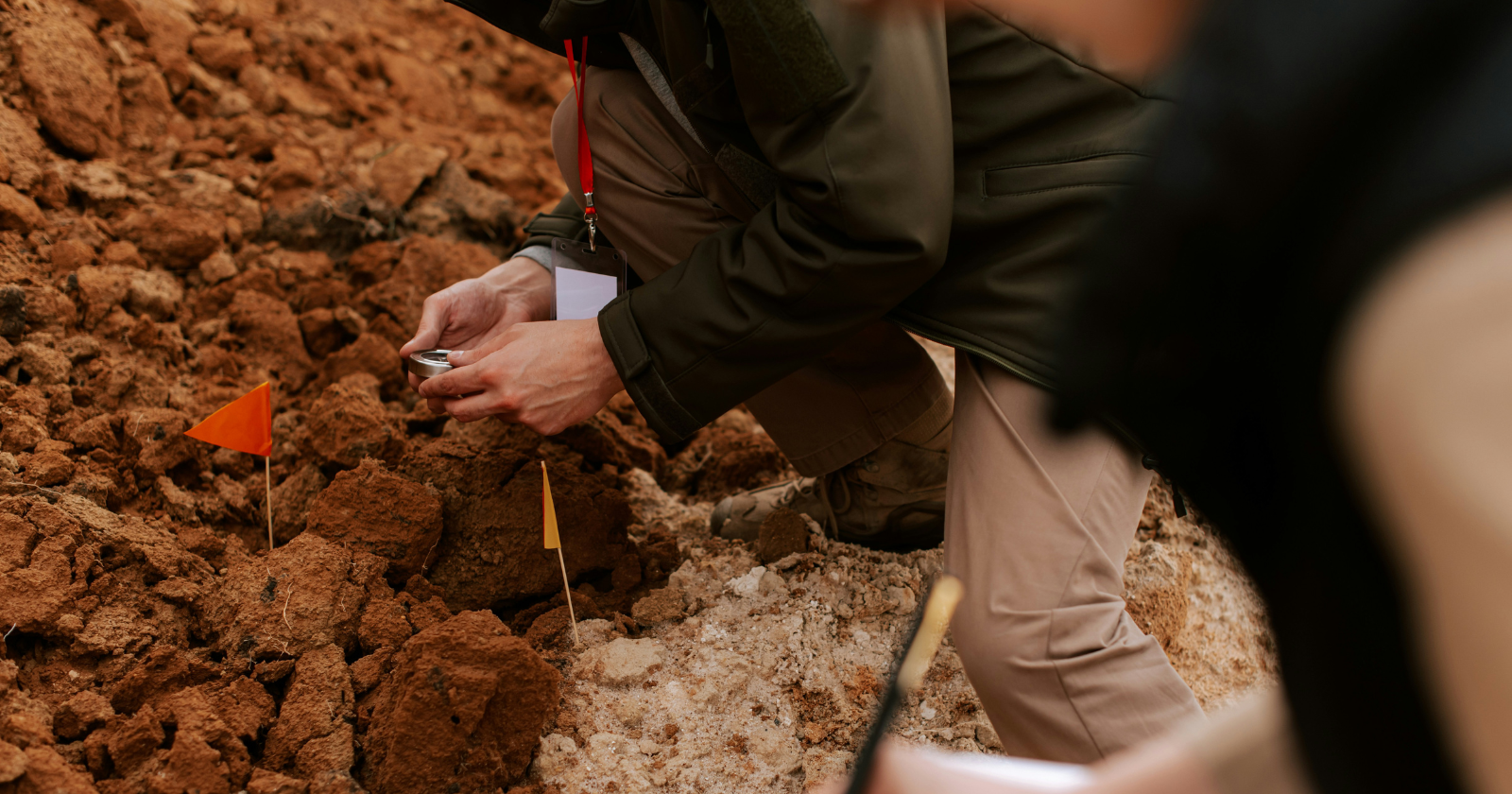
What has followed over the next two decades is one of the more quietly extraordinary transformations in how science understands the human past — one that relies not on the discovery of bones, but on the reading of dirt.
What the field was working with before
For most of the history of palaeogenomics, the study of ancient DNA, researchers needed physical remains. Ideally, well-preserved bones from cool, dry environments with enough surviving genetic material to sequence. Fossils meeting those requirements were rare, unevenly distributed across the world, and often inaccessible. The result was a picture of our ancient past that was necessarily incomplete, built on what happened to survive in the right conditions rather than what actually took place.
Neanderthals, Denisovans, and early modern humans left relatively few bones behind. The historical record of who lived where, when, and alongside whom was full of gaps that bones alone could never close. What those groups did leave, unavoidably and in abundance, was genetic material in the ground. Every time ancient humans shed skin cells, bled, or decayed, that DNA entered the soil beneath them. It bound to mineral particles. It settled into sediment layers that built up year by year, century by century. It waited.
The question was whether it could be retrieved, and whether the picture it revealed would hold up.
What changed
In 2003, Eske Willerslev and his colleagues published a study in Science showing that plant and animal DNA could be extracted from a Siberian permafrost core dating back 400,000 years. He later identified DNA from the extinct moa bird in 600-year-old cave sediments in New Zealand — the first time a complex organism had been identified using sediment alone. The technique gradually acquired a name: sedimentary ancient DNA, or sedaDNA. For a while, it stayed largely within palaeoecology, used to reconstruct past environments from lake beds and permafrost samples.
Then came 2017, which researchers in the field describe as a watershed year. Scientists successfully isolated human DNA from ice-age soils for the first time. It showed up at sites where no human fossils had ever been discovered. The sediment record and the fossil record were no longer the same record — the dirt was older, richer, and in many places, the only record that existed at all.
As Matthias Meyer at the Max Planck Institute for Evolutionary Anthropology in Leipzig has described the field, researchers are still “scratching the tip of the iceberg.” Sediments could eventually replace the need for fossil bones at many archaeological sites, giving access to genetic information from populations and time periods that left no skeletal trace at all.
What it is actually revealing
The clearest illustration of what sedaDNA can do comes from Denisova Cave in Siberia. The cave has become one of the most studied sites in all of palaeogenomics, in large part because it’s one of the very few places where Denisovans, Neanderthals, and early modern humans all appear to have been present. Most of what we know about Denisovans — a hominin group distinct from both Neanderthals and modern humans — comes from a handful of bone fragments recovered from this single cave. But sedaDNA from the same site has already pushed those timelines further back and filled in details no bone could provide.
In a study of roughly 700 permafrost sediment samples from the cave, researchers found DNA indicating that Neanderthals arrived at the site around 170,000 years ago, some 30,000 years earlier than fossil evidence had suggested. Early modern humans appear in the sediment layers from approximately 45,000 years ago, with no accompanying skeleton found so far. The dirt was keeping records that no one knew existed.
The technique has also started to answer a question that frustrated archaeologists for generations: who made which stone tools? DNA in stratified sediment layers can align with specific types of tools deposited at the same depth, potentially identifying the hominin group responsible for them. At Trou Al’Wesse cave in Belgium, sedaDNA confirmed a long-held hypothesis based purely on tool types — that Neanderthals had occupied the site, even though no bones were ever found there.
In 2022, Willerslev’s team pushed the method further still, extracting DNA from two-million-year-old permafrost at the northern tip of Greenland. It was the oldest genetic material ever recovered. When asked what those sediments actually contained, Willerslev told Nature: “You have humans, you have animals, you have plants, you have the whole bloody ecosystem.” That breadth, spanning multiple species and an entire ecological snapshot preserved in frozen ground, is something no single fossil could ever offer.
The archive we almost missed
The version of human history built on bones was never wrong — it was just incomplete. The ground has always held a fuller record. We simply hadn’t thought to ask it.
Where this leaves us
Researchers are now re-examining soil samples that were collected at archaeological sites decades ago, running modern sequencing methods on material that was stored without anyone knowing what it contained. Laboratories that once competed for rare fossil specimens are building sedaDNA programs. The technique is being refined to work in warmer climates — tropical and subtropical environments where DNA degrades far more quickly — and to capture nuclear DNA, which carries much richer information about ancestry and population mixing than mitochondrial DNA alone.
None of this is without complications. Sediment particles can shift. DNA can leach between layers. Contamination is a constant concern, and researchers cannot yet reliably predict which soils will preserve genetic material well. There are also ethical questions the field is navigating carefully: some Indigenous communities view the extraction of ancient DNA from sediments as a potential disturbance of ancestral presence, and researchers are increasingly engaging with communities before excavating rather than after. That collaboration is slow, but it is happening.
What stays with me about this research is not just the scale of what it has uncovered, but the logic of it. The assumption that understanding our ancient past required physical remains — bones, teeth, the hard residue of bodies — turns out to have been too narrow. The ground itself was holding information all along. Every layer of sediment at a significant site is potentially a genetic archive. Scientists are only beginning to learn how to read it.
There is something oddly personal about the idea that our ancestors left traces not just in their tools and their art and the rare bone that survived, but in the soil itself. That the past is not only in museums or in carefully catalogued specimens, but underfoot, stratified and waiting. The version of human history we thought we had is being updated, layer by layer, from the dirt.