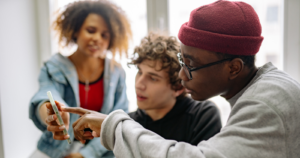
- Tension: Retirement promises understanding, yet technology creates an unbridgeable gap between generations.
- Noise: The assumption that shared love conquers all communication barriers across generations.
- Direct Message: Generational loneliness stems from technological change, not lack of caring.
To learn more about our editorial approach, explore The Direct Message methodology.
Last week, my 8-year-old granddaughter asked me to help her with a school project about “digital natives.” I stared at her laptop screen, watching her fingers dance across shortcuts I didn’t know existed, and realized I had become a tourist in her world.
When I retired in 2022 at 63, after 34 years in education, I thought I’d finally have time to truly connect with my grandchildren. Emma was five then, Lucas was three, and Sophie wasn’t even born yet. I pictured myself as the wise grandmother, sharing stories and life lessons, bridging past and present. Instead, I find myself struggling to explain a world that’s changing faster than my ability to understand it.
The loneliness isn’t about physical distance or lack of visits. It’s about watching my grandchildren navigate a reality I can barely comprehend, knowing the wisdom I spent decades accumulating feels increasingly irrelevant to their lives.
When your experience becomes ancient history
During my teaching career, I watched technology transform education. We went from overhead projectors to smart boards, from card catalogs to Google. I thought I was keeping up. But retirement created a gap — suddenly I wasn’t forced to adapt daily, and the world kept accelerating without me.
My grandson Lucas recently told me about a lockdown drill at school. How do you explain to a six-year-old that this wasn’t part of your childhood? That schools used to be places where the biggest worry was forgetting your lunch money? The historical context he’s living through — pandemic schooling, climate anxiety, digital surveillance — these aren’t just news items to him. They’re his normal.
I taught English literature for over three decades, analyzing how characters navigated their worlds. But I can’t fully explain the world my grandchildren inhabit because I’m still trying to understand it myself. Their childhood references — YouTube personalities, TikTok trends, online friendships — exist in spaces I can visit but never truly inhabit.
The language barrier nobody talks about
Remember when generation gaps were about music and fashion? Now they’re about entirely different ways of existing in the world.
Emma speaks fluently about algorithms, screen time limits, and digital footprints. These aren’t just new words — they represent concepts that shape her daily reality in ways I’m only beginning to grasp. When she shows me her digital art or explains her online learning platform, I feel like I’m watching through frosted glass. I see the shapes but miss the details.
The World Health Organization notes that “Social isolation and loneliness are widespread, with around 16% of people worldwide – one in six – experiencing loneliness.” But they don’t capture this particular flavor of isolation — being surrounded by loved ones yet separated by an invisible technological divide.
Even our shared activities have changed. Board games have become tablet games. Reading together now means navigating interactive ebooks with embedded videos. The simple pleasures I planned to share — baking cookies, tending gardens, writing letters — feel quaint against the backdrop of their digital native existence.
Missing the manual for modern grandparenting
Growing up, my own grandmother lived with us during her final years. I watched her share stories of the Depression, teach us to darn socks, and pass down recipes written on index cards. Her wisdom felt timeless and applicable. She could explain her childhood because its core experiences — work, family, community — remained recognizable even decades later.
But how do I explain dial-up internet to kids who’ve never known life without WiFi? How do I share the value of patience when everything in their world provides instant feedback? The acceleration of change has broken the traditional transmission of generational wisdom.
I see other grandparents at the park, smartphones in hand, desperately trying to capture and understand their grandchildren’s worlds. We’re all fumbling through this new reality, pretending the old playbook still works when clearly it doesn’t. We exchange knowing glances — that mix of love, confusion, and quiet grief for a simpler time when understanding between generations felt more natural.
Finding connection in the gaps
Despite this divide, or perhaps because of it, I’ve learned to find new ways to connect. I’ve stopped trying to be the teacher and become the student. Emma explains her coding class to me with the patience I once showed struggling readers. Lucas walks me through his favorite game, delighted when I remember the character names. Sophie and I share the simplest connection — peek-a-boo needs no translation.
I’ve discovered that admitting my confusion actually brings us closer. “I don’t understand this, can you show me?” has become my bridge. My grandchildren love being the experts, and I’ve learned that wisdom isn’t always about having answers. Sometimes it’s about asking the right questions and really listening to their responses.
We’ve found our overlap in unexpected places. Storytelling transcends technology — whether it’s through a book, a screen, or just talking at bedtime. Curiosity works in any era. Love doesn’t require WiFi.
The unexpected gift of not knowing
This technological divide has taught me humility in ways my teaching career never did. After decades of being the knowledge-keeper in the classroom, I’ve become the student again. It’s uncomfortable and sometimes lonely, but also oddly liberating.
I can’t give my grandchildren the same generational wisdom my grandmother gave me. But I can show them what it looks like to keep learning, to stay curious even when the world feels foreign, to admit when you don’t understand something. These might be more valuable lessons than any traditional wisdom I planned to impart.
The gap between us isn’t closing — if anything, it widens daily as technology advances. But I’m learning to see it differently. Not as a chasm that separates us, but as a space where we meet in the middle, each bringing what we can to the relationship.
Living with the beautiful ache
The loneliness I feel watching my grandchildren navigate their digital world isn’t going away. It sits alongside my love for them, a constant reminder that connection across generations now requires more intentional effort than ever before.
But maybe that’s the point. Easy understanding might have made us lazy. This challenge forces us to work harder at connecting, to be more creative in how we show love, to value the moments of true understanding even more.
I retired thinking I’d settle into a familiar world. Instead, I’m learning to be comfortable being uncomfortable, to find joy in confusion, to build bridges even when I can’t see the other side clearly. My grandchildren are living through history I can’t fully explain, but I can be present for it. I can witness their world even if I can’t entirely understand it.
What bridges are you building across the generational divide in your life? Because the gap isn’t getting smaller, but our capacity to love across it might just be growing stronger.