
To learn more about our editorial approach, explore The Direct Message methodology.
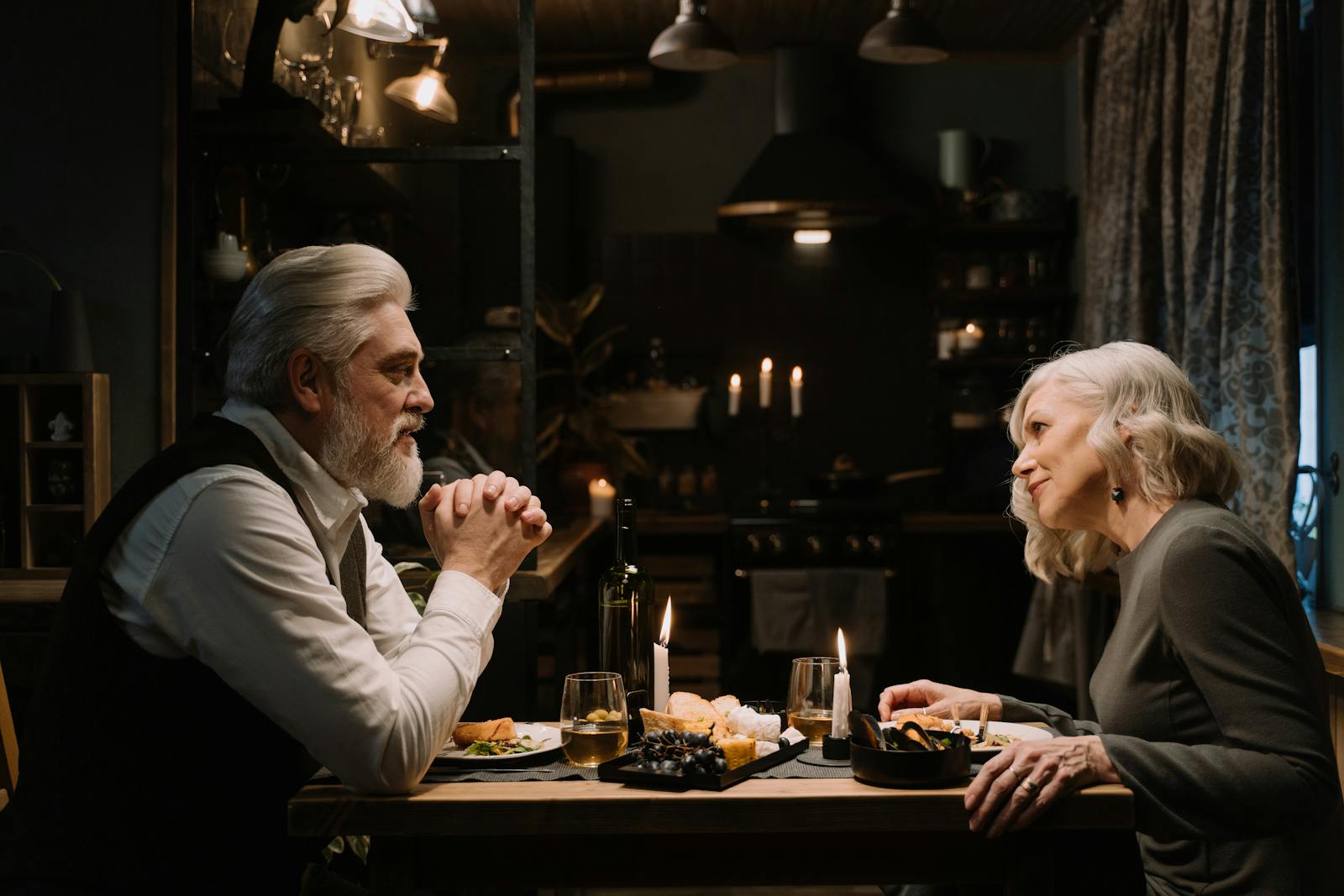
You have seen the couple at the next table. Two people who have clearly been married for decades, eating most of the meal without talking, and you feel a small reflexive sadness for them — look at that, they have run out of things to say. But there are two very different kinds of silence, and we mistake one for the other constantly. There is the silence of an empty room, and there is the silence of a room so lived-in and familiar that no one needs to narrate it. The long-married couple is usually sitting in the second one. We just keep reading it as the first.
The assumption underneath our sadness is that quiet means the love drained out — that romance died, that they became roommates, that the spark we are all supposed to chase went cold. Sometimes, of course, a quiet marriage really is a dead one. But far more often the quiet is not an absence at all. It is the particular sound a very secure bond makes once it no longer has anything to prove.
What actually happens to love over decades
Part of this is just the well-documented arc of love itself. The breathless, can’t-stop-talking phase of early romance — what researchers like Elaine Hatfield call passionate love — has a famously short shelf life, usually a few years at most before it cools. That is not a malfunction; it is the design. What takes its place in enduring couples is a different thing entirely. In Robert Sternberg’s triangular theory of love, it is called companionate love — the blend of intimacy and deep commitment, described as “a calm sense of commitment” rather than a fire.
And companionate love is exactly the kind that ages well. As the science writers at The Anatomy of Love put it, older couples “with a lifetime of shared history” are often perfectly content with companionate love. The fire was never meant to burn at full height for fifty years. What replaces it is not less than love. It is a steadier, lower-burning version that does not need constant fuel to stay warm — and one of the ways you can tell it is there is that the people inside it stop needing to talk all the time.
The trouble is that we are not really taught to value this. The culture sells the fire — the grand gestures, the butterflies, the couples who still finish each other’s sentences breathlessly after thirty years — and quietly implies that if the fireworks stop, something has gone wrong. So couples sitting in perfectly healthy companionate love sometimes panic at their own contentment, mistaking calm for decline and going looking for a spark that was always meant to be temporary. The quiet they have started to mourn is, very often, exactly what long-term success was going to look like all along.
Why the silence is earned, not empty
Here is the part the title is pointing at, and I will own it as my own reading rather than a finding from a study. A comfortable silence between two people is not a starting condition. It is an achievement. Early on, you fill every gap — you talk to be known, to be reassured, to close the distance, to make sure you are still on the same page. You cannot afford much silence yet, because silence still feels like uncertainty. Decades later, the important things have been said, and said, and absorbed. You already know what the other person thinks about almost everything that matters. The silence is no longer a gap to be anxiously filled; it is shared ground you can both just stand on.
That is why long-married silence can be so deeply companionable. Being quiet with someone is only relaxing when you feel completely safe with them — when you do not have to perform, explain, or maintain anything. Most of us have exactly a handful of people in our entire lives we can sit in silence with and feel more at ease, not less. For the lucky long-married, their person is the first name on that very short list. The quiet is not the love leaving the room. It is proof that the room is safe.
When quiet is what safety sounds like
Being comfortable in silence with someone is only possible when you feel completely safe with them — when there is nothing left to perform, explain, or maintain. For the long-married, that quiet is not the love leaving the room. It is the proof that the room is finally, fully theirs.
The silence that isn’t the good kind
I want to be honest and not romanticize every quiet marriage, because not all silence is the warm kind. There is also the cold silence of two people who have given up — where the quiet is full of resentment, avoidance, or contempt, and the not-talking is a wall rather than a shared room. The difference is usually easy to feel from the inside, even when it looks identical from the next table. Comfortable silence feels like rest; you could speak, you simply do not need to. The other kind feels like holding your breath. If the quiet in a relationship is the breath-holding kind, that is worth paying attention to and, if it helps, talking through with someone — that silence is saying something, and it is not “we are at peace.”
I am still early enough in my own marriage that I notice the urge to fill the air — to check in, to make sure we are fine, to keep the conversation moving. But every so often we land in a stretch of easy quiet, driving somewhere or moving around the kitchen, and I catch a glimpse of the other thing: the version where silence is not a problem to solve but a comfort to share. I suspect that is what the couple at the next table figured out a long time ago.
So the next time you see two people who have been together forever sitting in unbroken quiet, you might resist feeling sorry for them. Odds are they are not out of things to say. They are simply past the point of needing to say them, resting in a silence they spent decades earning the right to share. The love did not fade into that quiet. The love is what made the quiet feel like home.