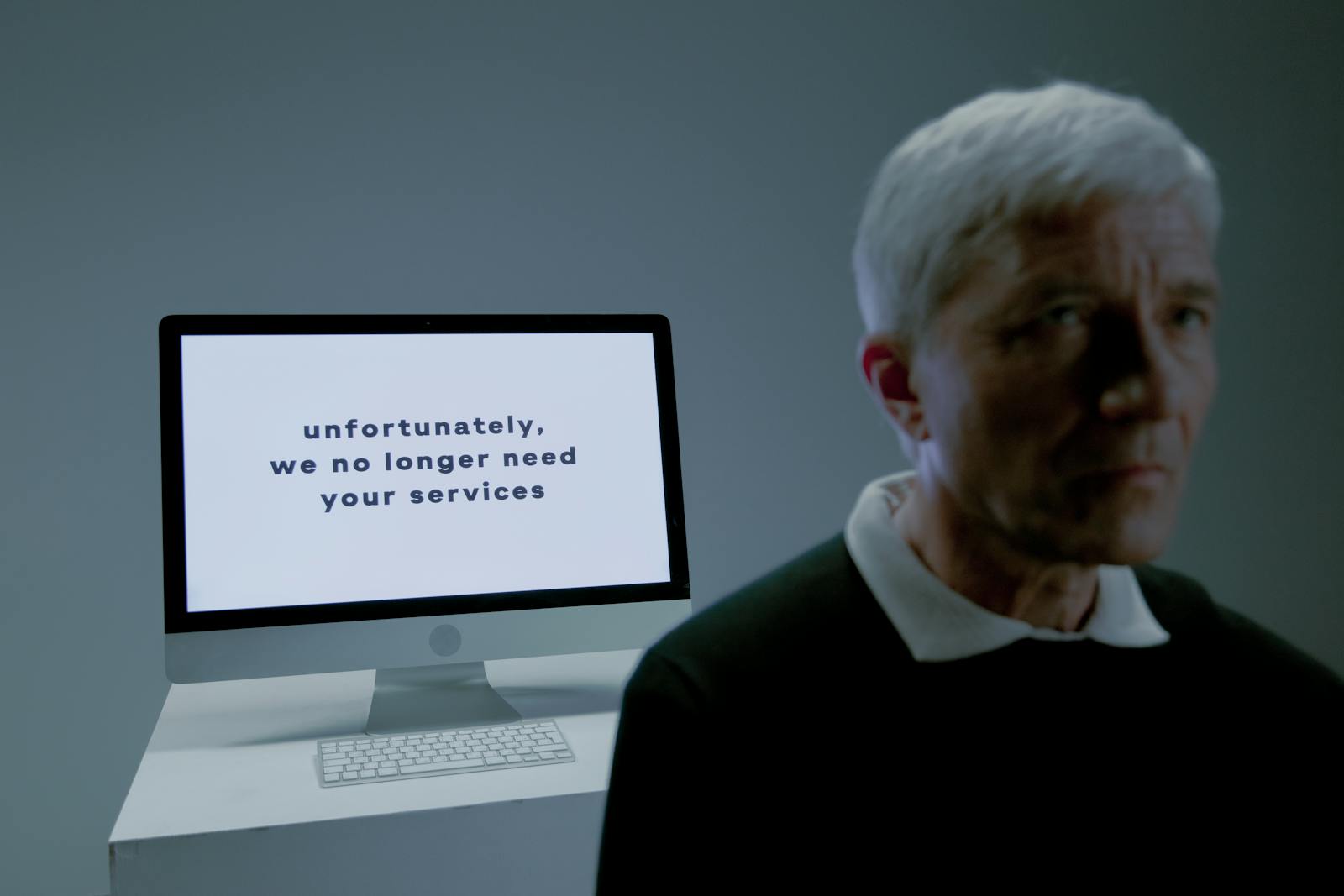

- Tension: Men who loved their careers are the ones most devastated by retirement — not because they miss the work, but because their entire identity was built on being needed, and that need vanished overnight.
- Noise: The retirement industry obsesses over financial readiness while ignoring the psychological freefall of role loss, purpose atrophy, and social isolation that disproportionately crushes men who never built an identity outside the office.
- Direct Message: The only retirement plan that actually matters answers a question no spreadsheet can model: who are you when no one is paying you to be someone? The men who survive this transition aren’t the wealthiest — they’re the ones who cultivated necessity outside of work before work disappeared.
To learn more about our editorial approach, explore The Direct Message methodology.
Gary retired on a Friday in March. His coworkers at the engineering firm in Columbus threw him a party with a sheet cake and a card signed by forty-three people — some of whom he’d worked beside for two decades. His wife, Linda, had planned a dinner that evening with their adult kids. Everyone toasted. Everyone smiled. By Monday morning, Gary was sitting at the kitchen table at 6:47 a.m. in the same khakis he’d worn to work for years, drinking coffee and staring at the backyard. Linda found him there an hour later. He told her he was fine. He told himself the same thing for the next eleven months — right up until the morning he couldn’t remember why he’d gotten out of bed at all.
I hear versions of Gary’s story constantly. Not from financial advisors or retirement planners — from wives, from adult daughters, from the men themselves when they finally find language for what’s happening. And what’s happening has almost nothing to do with money.
The financial services industry has spent decades terrifying us about retirement — will you have enough? Have you saved enough? The 401(k) projections, the Monte Carlo simulations, the grim actuarial tables. And those concerns are real. But the crisis unfolding in living rooms and garages and quiet home offices across the country isn’t about depleted savings accounts. It’s about depleted identity. Psychologists call it role loss — the disorientation that follows when the social role that organized your life, your relationships, and your self-concept simply vanishes. For men especially — men who were taught that their value lives in what they produce — retirement doesn’t feel like freedom. It feels like erasure.
Consider the research. A 2017 study published in the Journal of Epidemiology and Community Health found that retirement was associated with a significant increase in depressive symptoms — and the effect was strongest among men who had high job satisfaction. Not the men who hated their work. The men who loved it. The men who had built their entire psychological architecture around being needed, being competent, being the person others relied on.

Tom, a 67-year-old former logistics manager in Tucson, described it to me with startling precision. “I didn’t lose my job,” he said. “I lost the reason anyone would call me during the day.” His phone — once a constant stream of questions, updates, minor emergencies — went silent. And that silence wasn’t peaceful. It was annihilating.
We’ve explored before how grief isn’t always about what’s gone — it’s about every future moment that thing will never touch. Retirement grief works the same way. It’s not nostalgia for the office. It’s the slow realization that you’ll never again be the person who fixes things, who knows things, who gets consulted because you’re the one with thirty years of institutional memory. That future version of yourself — the one who matters in a specific, daily, undeniable way — doesn’t exist anymore.
And the cultural messaging around this is almost aggressively unhelpful. “Enjoy your golden years.” “You’ve earned this.” “Go play golf.” As if decades of purpose can be replaced by a hobby. As if identity is a faucet you can simply redirect. Naomi, a clinical psychologist in Portland who specializes in later-life transitions, told me that the men she sees in her practice almost never present with “I’m depressed about retirement.” They present with insomnia. With irritability. With vague physical complaints that send them through a revolving door of specialists. We’ve seen this pattern in other health contexts — the real issue hiding behind symptoms that look like something else entirely.
What Naomi calls purpose atrophy works slowly. It doesn’t announce itself. It accumulates. A man stops shaving every day. He watches more television — not because he enjoys it, but because it fills the hours. He starts arguments about nothing. He follows his wife around the house until she snaps at him, and then he retreats, and the retreating becomes a pattern, and the pattern becomes a life.
A 2020 paper in The Journals of Gerontology examined what the researchers called “retirement-induced social isolation” and found that men were significantly more likely than women to experience a dramatic reduction in social contact after leaving the workforce. The reason was structural, not emotional: women, on average, had maintained friendships and community ties independent of work. Men had not. Their social world was work. When work ended, so did the social world.
Marcus, a 71-year-old retired insurance adjuster in Memphis, put it bluntly: “My wife has book club, her garden group, three friends she talks to every week. I had Jim from accounting. Jim moved to Florida.”

There’s a concept in psychology called mattering — the perception that you are significant to other people, that your presence or absence would actually be noticed. Research on mattering consistently shows it’s one of the strongest predictors of psychological wellbeing in older adults. Not happiness. Not satisfaction. Mattering. The sense that you are consequential to someone’s day.
And this is where the retirement crisis becomes a health crisis. We’ve covered the cognitive risks that come from well-intentioned but misguided approaches to brain health — but one of the most overlooked cognitive risks in older men is simply having nothing that demands their full attention. The brain doesn’t decay because of aging alone. It decays when it stops being asked to solve problems, navigate complexity, engage with novel challenges. A man who goes from managing a team of twenty to managing his Netflix queue isn’t resting his brain. He’s starving it.
I think about Daniel Radcliffe’s recent comments about avoiding franchise work — his insistence on choosing projects that demand something of him rather than simply sustaining what’s familiar. That instinct — the refusal to coast on a role that no longer challenges you — is exactly what most retirement advice gets wrong. The answer isn’t to find something to fill the time. It’s to find something that asks something of you.
The men who navigate this transition well — and I’ve met some — share a common trait. It isn’t optimism, or wealth, or even health. It’s what I’d call identity plurality. They were never only one thing. Before retirement, they had already cultivated at least one domain of competence and connection that existed entirely outside the office. Derek, 69, a retired civil engineer in Raleigh, had been volunteering with Habitat for Humanity for a decade before he left his firm. The transition was still hard — he’ll tell you that honestly — but he had somewhere to go on Monday morning. Somewhere people expected him. Somewhere his skills were not just useful but necessary.
That word — necessary — keeps coming up in every conversation I have about this. Not valued. Not appreciated. Necessary. There is a specific kind of oxygen that comes from being needed, and it is different from being loved. You can be deeply loved by your family and still suffocate from the absence of necessity.
The retirement planning industry won’t tell you this. They’ll sell you a portfolio review. They’ll model your withdrawal rate. They’ll show you projected healthcare costs in a spreadsheet with color-coded risk levels. And none of it — not one cell in that spreadsheet — will address the morning you wake up and realize that nobody is waiting for you anywhere.
What saves men in this moment isn’t a plan. It’s a practice — built before the party, before the cake, before the signed card. It’s the quiet, unglamorous work of becoming someone who exists outside the office before the office disappears. Of tending friendships that don’t depend on shared deadlines. Of learning something hard — not because you need to, but because the difficulty itself is the point. Of finding a place where your absence would leave a gap.
Gary, the engineer from Columbus, eventually found his way. Not through therapy — though he’ll admit now he probably should have gone — but through his neighbor’s garage. The neighbor was rebuilding a 1969 Chevelle and needed help with the electrical system. Gary started showing up. Then he started showing up earlier. Then he started bringing his own tools. It took eight months, but one morning Linda noticed he was already dressed and out the door by seven.
She didn’t say anything. She didn’t need to. The man she’d worried about — the one sitting at the kitchen table with nowhere to go — had found the one thing no retirement account can provide. A reason to be somewhere. A person waiting for him. A problem that needed his specific hands.
The crisis nobody warns men about isn’t financial. It’s existential. And the only retirement plan that addresses it is the one that answers a question no spreadsheet can model: Who are you when no one is paying you to be someone?