
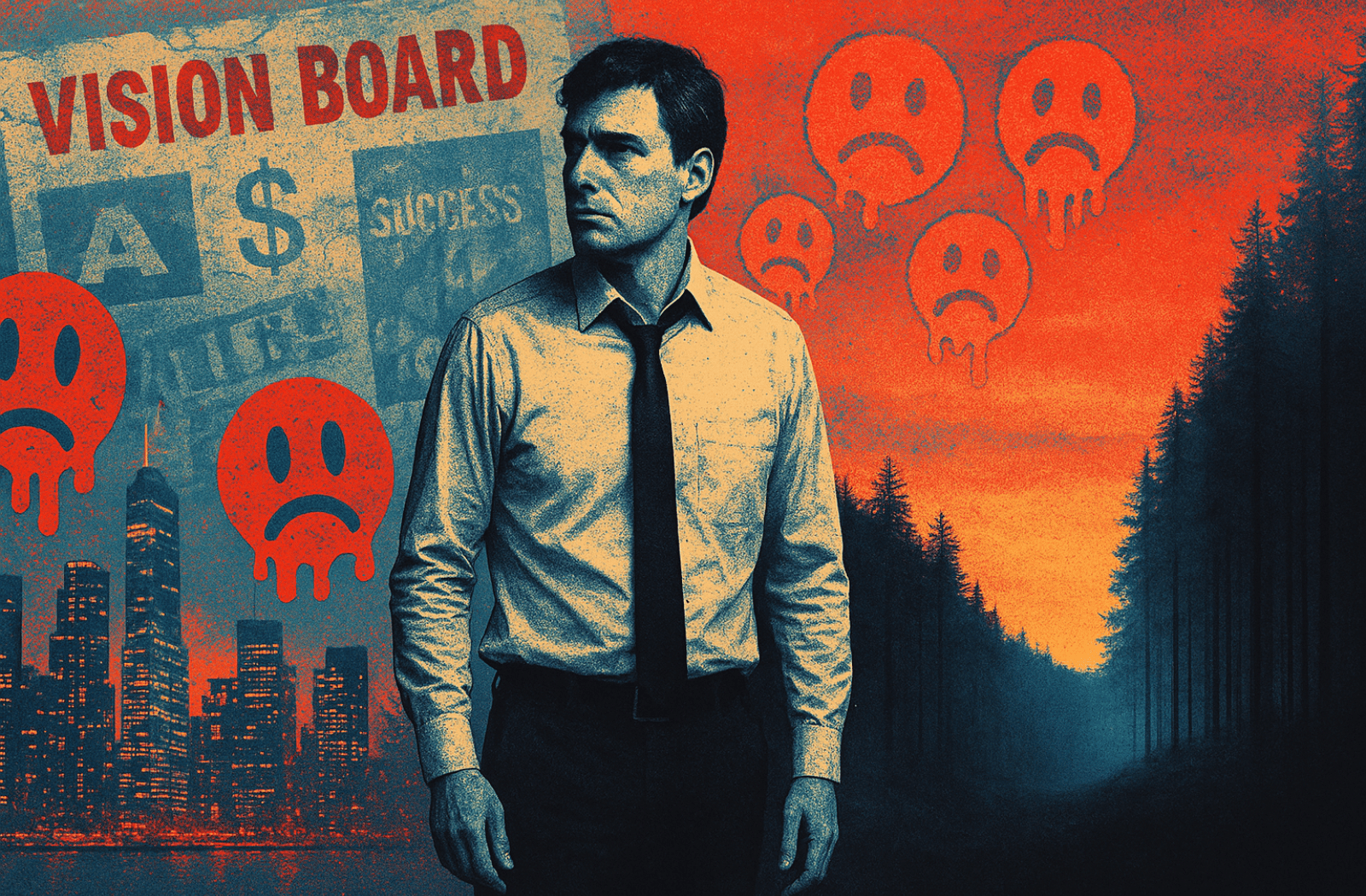
This article follows the Direct Message methodology, designed to cut through the noise and reveal the deeper truths behind the stories we live.
For years, I was obsessed with thinking positively.
I honestly believed it was the key to everything—success, confidence, emotional strength, even spirituality. I treated every setback like it was some cosmic lesson in disguise. I told myself that if I just reframed my thoughts, if I could turn every pain into a gift, then I’d be untouchable.
And for a while, it kind of worked.
From the outside, I was building what looked like a pretty successful life. I had the online businesses. The lifestyle freedom. The carefully curated personal brand that said, “Here’s a guy who’s figured things out.”
But underneath it, I was exhausted.
Not physically. Existentially.
There was this growing dissonance between the image I was projecting and the truth I didn’t want to admit to myself: I was no longer living my life. I was performing it.
When things weren’t working out the way I wanted, I’d double down on positivity. I’d flood my journal with gratitude lists. I’d smile and say “it’s all unfolding perfectly” even when something in me knew it wasn’t. I got really good at using spiritual language to override very real discomfort.
It felt noble, even enlightened at times. But it was also a trap.
Because I wasn’t actually listening to myself.
That realisation hit me one afternoon during a so-called “successful” launch. We’d just wrapped up a campaign that hit the numbers. The team was excited. The audience responded. The metrics all looked good.
But I felt… empty.
Not just tired. Empty.
It scared me. Because for years, I’d been building this life around the idea that success would eventually bring me something real—peace, joy, purpose. But here I was, having ticked all the right boxes, and none of those things were present.
I realised I’d been chasing someone else’s definition of success.
The revenue targets. The freedom lifestyle. The public perception of being a “thought leader.” These weren’t goals that emerged from within me. They were adopted. I’d absorbed them from mentors, from books, from podcasts, from the culture of hustle and grind and endless optimization.
And because I was so focused on staying positive, I never questioned them.
Positivity had become a kind of mental censorship.
Anytime frustration or doubt crept in, I’d dismiss it. I’d tell myself I was being ungrateful. That I needed to “shift my energy.” That I just needed to raise my vibration, realign my intentions, get back into flow.
But that was just another way of ignoring my truth.
What changed everything was when I stopped trying to override those uncomfortable emotions—and started listening to them instead.
I let myself get angry. Really angry. Not at anyone in particular—but at the years I’d spent suppressing my own instincts. At the hours of fake optimism I’d forced myself to perform just to stay “on brand.”
I let the anxiety speak too. I stopped silencing it with breathwork and affirmations and productivity hacks. And when I really listened, I realized that anxiety wasn’t trying to sabotage me. It was trying to protect me—from a path I wasn’t meant to be on anymore.
Frustration became a compass.
Sadness became a mirror.
Boredom became a wake-up call.
These were not obstacles to be overcome. They were guideposts.
They pointed to the parts of my life where I was still performing. Still trying to be impressive. Still playing the role of the guy who’s got it all together.
And one by one, I started letting go.
Not of my ambitions—but of the need for them to look a certain way.
I redefined success on my own terms.
Not by writing it down on some vision board, but by stripping away the layers of performance. By asking myself what actually felt true—not just what looked good from the outside.
And I discovered something wild.
The more I embraced my full emotional range—without trying to fix it or spin it—the more grounded and confident I became.
I started building things from a place of alignment rather than ambition.
Not “What will get the most clicks?”
Not “What’s the next growth hack?”
But “What feels meaningful, even if no one sees it?”
I stopped needing validation.
Stopped needing to feel “positive” all the time.
Stopped needing to win in ways that made other people impressed but left me numb.
And ironically, that’s when I became more successful.
Not just financially—though that came too—but in a deeper, more integrated way.
I built projects that mattered to me.
I attracted collaborators who resonated with who I actually was, not the version I’d been performing.
I made sharper decisions because I wasn’t second-guessing myself all the time.
Success became less about the outcome and more about the integrity of the process.
Not because I’d mastered some mindset formula. But because I’d finally dropped the performance.
This is the part they don’t tell you in self-help books: positivity isn’t always empowering. Sometimes it’s just another way to avoid intimacy—with yourself, with others, with reality.
What actually makes you powerful is the ability to stay with yourself—even when things feel raw, chaotic, or uncertain.
Especially then.
That’s where your real compass is.
Not in how good you are at manifesting.
Not in how quickly you can bounce back.
But in your willingness to feel what’s real—and trust that your life will recalibrate around that.
I don’t live in the land of forced positivity anymore.
I live in truth.
And if that truth sometimes feels heavy, confusing, or inconvenient, I’ll take that over fake lightness any day.
Because at least now, every step I take is mine.
This shift—of going inward instead of outward, of feeling instead of performing—has been the most important change in my life. It’s what made me more successful, not less. And it’s also why I’m proud to have helped produce a free masterclass on The Vessel called The Art of Love and Intimacy. (The Vessel is operated by Brown Brothers Media, so we may earn money if you buy through this link.)
It’s not just about relationships with others—it’s about the relationship you have with yourself.
There’s one exercise in it that’s especially powerful, designed to help you get radically honest about who you are and what you really want, beneath the layers of conditioning.
If what I shared in this article resonates with you—if you’ve been faking it too, or chasing other people’s standards of success—I really recommend checking it out. It might just be the thing that reconnects you with your real compass.