
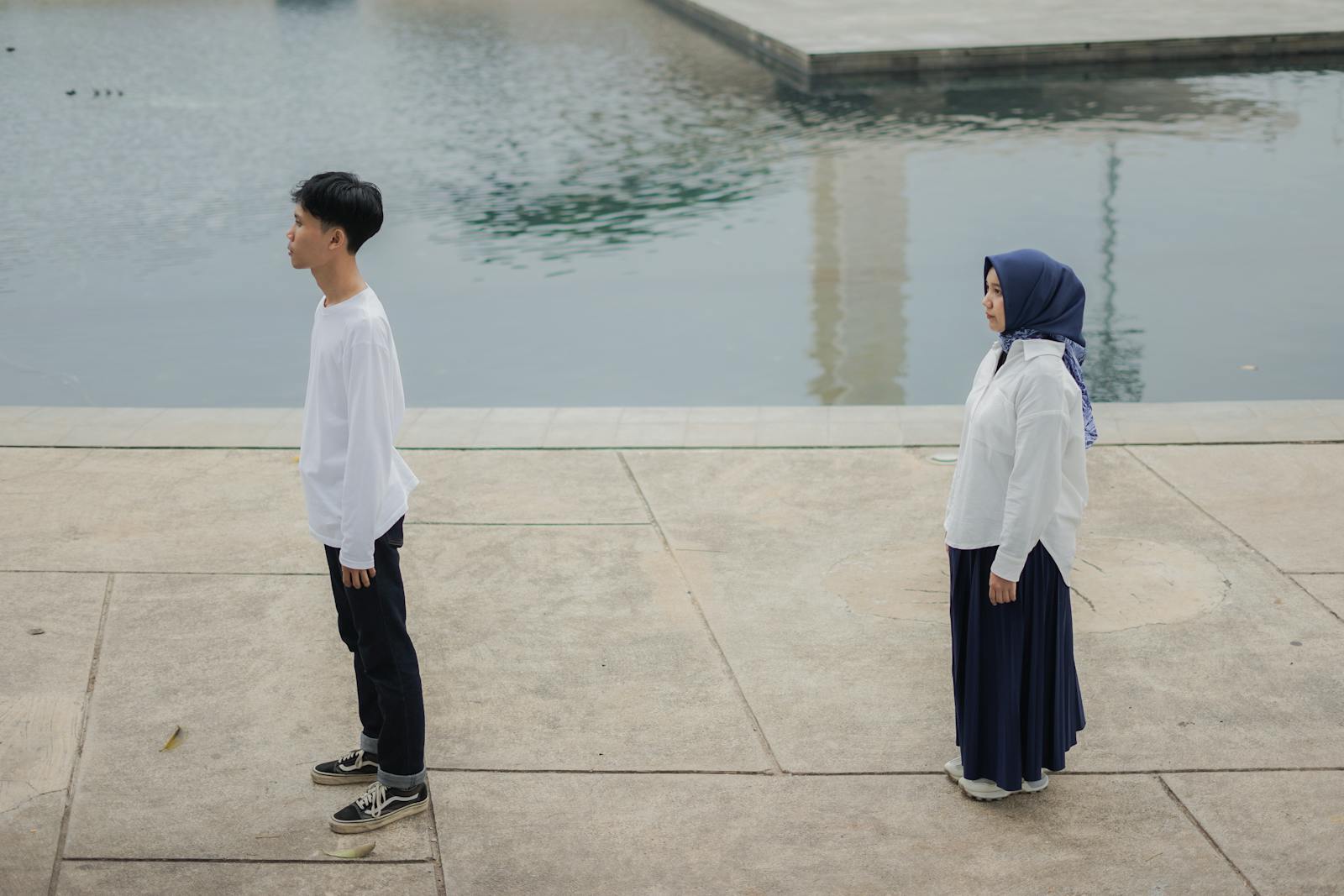
Nadia Kowalski, a 39-year-old speech pathologist in Milwaukee, can pinpoint the exact moment her brother became someone she no longer recognized. It wasn’t during a fight. There was no slammed door, no cruel remark over Thanksgiving dinner, no inheritance dispute. It was a Saturday in March 2024, and she was sitting across from him at a diner they’d gone to as kids, watching him talk about his life in a way that made her feel like she was listening to a stranger describe a childhood she’d never lived. He remembered their father as strict but fair. She remembered their father as someone who made her afraid of the sound of keys in a door. Same man. Same house. Two entirely different histories.
They finished their eggs. They hugged in the parking lot. And she drove home knowing something she’d been circling for years: the distance between them had nothing to do with conflict and everything to do with the fact that they had metabolized the same raw material into incompatible selves.
This is a kind of grief that doesn’t have good language yet. It isn’t estrangement born of betrayal. It isn’t the clean break of a sibling who stole money or chose addiction over family. It’s the slow, bewildering drift that happens when two people who shared a bedroom, shared parents, shared the specific humidity of a particular house in a particular decade, grow so fundamentally different that proximity itself becomes a reminder of an unbridgeable gap.
And it’s far more common than most people think. Research suggests that a significant portion of American adults experience some form of sibling estrangement—a rate that appears to exceed estrangement from parents, grandparents, or children. Siblings, the people who are supposed to be our longest-lasting relationships, are the ones we lose most often.

The cultural conversation around family estrangement tends to focus on dramatic causes: abuse, addiction, money, religion, political fractures. And those causes are real. But they account for only part of sibling distance. A quieter, less discussable portion comes from something harder to name: the realization that surviving the same family didn’t produce the same person, and that the version of your sibling who exists now is someone you might not choose as a friend, or even recognize as kin, if you met them for the first time at a party.
Derek Osei, 46, a logistics coordinator in Atlanta, describes it in mechanical terms. He and his younger sister grew up in a household shaped by their mother’s depression and their father’s long absences for work. Derek coped by becoming hyper-responsible, taking over the grocery shopping at thirteen, managing household bills by sixteen. His sister, Amara, now 42 and living in Portland, coped by disappearing into books, friendships, and eventually a spiritual community that Derek finds baffling. “She talks about our childhood like it was this mystical journey,” he says. “I was just trying to keep the lights on.”
They aren’t angry at each other. They don’t argue. They simply have no shared framework for what happened to them, and that absence of shared meaning has hollowed out the relationship from the inside.
Psychologist Joshua Coleman, who researches estrangement and works with estranged families, points to a broader cultural shift that helps explain why this kind of sibling drift has become so prevalent. Relationships that were once sustained by obligation and proximity are now evaluated through the lens of emotional alignment. British sociologist Anthony Giddens called these “pure relationships,” bonds maintained not by duty but by how well they serve each person’s aspirations for happiness, personal growth, and mental health. When a sibling relationship stops feeling emotionally nourishing, the modern instinct is to let it go rather than maintain it out of loyalty to a shared past.
But calling it a choice misrepresents what’s actually happening. For most people, the drift doesn’t feel like a decision. It feels like gravity.
Research on sibling relationships shows that siblings function as each other’s earliest social mirrors. They shape one another’s identities through comparison, competition, and role differentiation. One child becomes “the responsible one” precisely because another child has already occupied “the creative one” or “the difficult one.” These roles, assigned in childhood, calcify over decades. And when adults try to relate to each other outside of those roles, they often find there’s nothing underneath. The role was the relationship.
This is the part that cuts deepest. The version of childhood each sibling carries is the version that made survival possible. Derek needed to believe his hyper-responsibility was heroic. Amara needed to believe her withdrawal was spiritual evolution. Both narratives are true from the inside. Both are incomprehensible from the other’s position.
Coleman notes that divergent memories of the same family are not evidence of dishonesty or pathology. Studies have shown that genetics, temperament, birth order, peer relationships, and even simple luck all shape how a child processes the same household environment. Two siblings can experience the same parental behavior in categorically different ways. One child’s “normal discipline” is another child’s formative wound. The family isn’t lying to itself. It’s telling multiple truths simultaneously, and those truths don’t add up to a single coherent story.
Maren Ljungqvist, a 33-year-old graphic designer in Minneapolis, discovered this at her older brother’s wedding two years ago. Sitting at the family table, she listened to her brother give a toast thanking their parents for “always being there.” She felt her throat close. Her experience of those same parents involved years of emotional neglect that she’d spent a decade working through in therapy. Her brother wasn’t being dishonest. He genuinely experienced a different family.
“I kept looking at him and thinking, we didn’t grow up in the same house,” Maren says. “We grew up in the same building. But the houses were different.”
This distinction matters because it reframes the grief. Maren isn’t mourning a brother who wronged her. She’s mourning the impossibility of being fully known by the person who, by all logic, should know her best. That particular loneliness, of being close to someone who will never fully see you, is one of the most disorienting experiences a person can have, because it contradicts the story we tell ourselves about what family means.
The cultural script says that shared blood and shared experience produce deep, automatic understanding. Siblings are supposed to be the people who “get it” without explanation. When that doesn’t happen, the absence feels like a personal failure rather than a structural inevitability.

Family therapist Murray Bowen’s concept of differentiation, developed in the 1970s and still foundational to sibling relationship research, describes the process by which individuals separate their emotional identity from their family of origin. Bowen observed that in families with high anxiety or dysfunction, children tend to differentiate in opposite directions. One becomes enmeshed with the family system. Another detaches entirely. A third finds some middle ground. The directions they choose aren’t random. They’re survival strategies, shaped by temperament, birth order, and the specific emotional weather of the household at the time each child was most vulnerable.
What Bowen’s framework reveals is that sibling divergence isn’t a bug. It’s a feature. The same family system that produces one child’s loyalty produces another child’s flight. And the further each sibling travels along their particular trajectory, the harder it becomes to find common ground.
Consider the math of it. Two people who spent eighteen years in the same house have now spent twenty, thirty, forty years apart. Each year adds new experiences, new relationships, new beliefs that were formed in response to their particular survival strategy. Derek’s hyper-responsibility led him to a pragmatic career, a structured marriage, a worldview organized around control. Amara’s withdrawal led her to alternative spirituality, a fluid relationship with employment, a worldview organized around surrender. They aren’t just different. They are differently constructed at the level of operating assumptions about what life is for.
Psychologist Joshua Coleman notes that while therapy and self-help culture have helped many people identify painful patterns and validate childhood experiences, these same tools have sometimes produced a kind of psychological determinism. One sibling may frame the family through the vocabulary of trauma and boundaries. The other may frame the same family through the vocabulary of gratitude and resilience. Both frameworks are internally consistent. Both are validated by entire communities of people who share them. And they are functionally untranslatable to each other.
The small slights between siblings often carry more weight than dramatic betrayals, precisely because they come from someone who was supposed to understand without being told. When a sibling minimizes your pain, or romanticizes a childhood that felt suffocating to you, or simply fails to ask the right question at a funeral, the sting is disproportionate to the act. It’s not about the comment. It’s about the proof that understanding was never automatic, that the bond you assumed was built into your shared DNA was actually conditional on a shared interpretation of experience that never existed.
Nadia Kowalski eventually stopped trying to correct her brother’s memory. She stopped sending him articles about childhood emotional neglect. She stopped expecting the conversation where he’d finally say, “I see what you went through.” She didn’t cut him off. She just stopped reaching for something that wasn’t there.
“I used to think we were two chapters of the same book,” she says. “Now I think we’re two books that happen to reference the same address.”
The grief in this is specific and lonely. There’s no villain. There’s no dramatic incident to point to when people ask what happened. There’s only the slow recognition that the person who should be your closest witness to your own life is, in fact, living in a parallel reality where the same events carry opposite meanings. And the distance between those realities only grows.
Maren Ljungqvist still sees her brother at holidays. They are cordial. They exchange gifts for each other’s children. But she has stopped expecting the relationship to feel like family in the way she once imagined it should. She has started to grieve not the brother she lost, but the brother she never had: someone who shared her experience, not just her address.
That distinction, between losing a sibling and realizing you never had the sibling you thought you did, is where the sharpest pain lives. A death has rituals. A fight has a narrative. But discovering that your closest genetic relative is a stranger who happens to share your last name and the memory of a kitchen wallpaper pattern offers no script, no ceremony, no clean resolution.
What remains is this: two people, shaped by the same fire, carrying different scars, walking in different directions, occasionally glancing back. Not with anger. With something closer to bewilderment. The kind of look you’d give someone standing on a shore you can no longer reach, not because the water is too rough, but because you can no longer remember how to swim toward a place that was never really home for both of you at the same time.