- Tension: Birdwatchers score significantly higher on cognitive tests than non-birders — even when researchers control for exercise, education, and general nature exposure. The advantage persists in ways that simple walking or outdoor time can’t explain.
- Noise: We assume cognitive benefits come from physical activity, brain-training apps, or relaxation. But the birding advantage isn’t about movement or calm — it’s about a specific, demanding type of multi-sensory attention that most modern habits actively suppress.
- Direct Message: The brain doesn’t atrophy from age alone — it atrophies from attentional disuse. Birdwatching forces sustained, voluntary, outward attention — the exact cognitive capacity we lose first — and it turns out that simply choosing to notice the world around you is one of the most powerful neuroprotective behaviors available.
To learn more about our editorial approach, explore The Direct Message methodology.
Gerald, a 71-year-old retired postal worker in Tucson, failed his first cognitive screening in 2019. Not catastrophically — just enough that his doctor suggested he “keep an eye on things.” His daughter bought him a pair of Nikon Monarch binoculars for Christmas that year, mostly because she didn’t know what else to get a man who already owned too many flannel shirts. He started walking the wash behind his subdivision at dawn, trying to identify the birds that had been background noise for thirty years. Within eighteen months, he aced his follow-up screening. His doctor was surprised. Gerald wasn’t. “My brain,” he said, “started working differently out there.”
This is not a miracle story. Gerald didn’t cure anything. But what happened inside his skull during those mornings in the desert scrub is exactly what a growing body of research has been documenting — and the mechanism turns out to be both more elegant and more mundane than anyone expected.
A 2022 study published in Ecological Economics found that birdwatchers scored significantly higher on measures of attention, working memory, and cognitive flexibility compared to non-birders of the same age and education level. The gap wasn’t trivial. On some metrics, regular birders performed as though they were cognitively five to eight years younger. The researchers controlled for physical activity levels, socioeconomic status, general nature exposure — the usual confounds. The birdwatching advantage persisted.
The obvious guess is exercise. Birders walk. Walking is good for brains. Case closed.
Except it’s not that simple. The study participants who took regular walks without birdwatching didn’t show the same cognitive bump. And birders who mostly watched from stationary feeders — barely moving at all — still outperformed the control group. Something else was happening.

Naomi, a 58-year-old data analyst in Portland, started birding during the pandemic lockdowns like a lot of people did. “I figured I’d learn maybe ten birds and get bored,” she told me. Three years later, she maintains a life list of 387 species and can distinguish a Cassin’s vireo from a warbling vireo by ear alone. What struck her wasn’t the hobby’s relaxation factor — it was the intensity. “People think birdwatching is passive,” she said. “It’s the opposite. Your brain is running at full speed the entire time.”
She’s describing what researchers call attentional foraging — a cognitive state where the brain simultaneously scans broadly for movement and sound while preparing to narrow focus instantly on a specific target. It’s the combination of diffuse awareness and sharp concentration, toggling between the two in rapid cycles. Your visual cortex is processing color, shape, size, and flight pattern. Your auditory cortex is parsing a dozen overlapping bird songs, filtering signal from noise. Your memory systems are pulling up reference images, comparing field marks, retrieving habitat associations. And you’re doing all of this while navigating uneven terrain and adjusting to changing light.
That cognitive cocktail — simultaneous broad-spectrum attention plus rapid pattern recognition plus episodic memory retrieval — is precisely the suite of skills that deteriorate earliest in age-related cognitive decline. Birdwatching doesn’t just exercise the brain generically. It drills the exact capacities we lose first.
A 2023 paper in Urban Forestry & Urban Greening pushed the finding further. Researchers in the UK measured cortisol levels and administered cognitive tests to over 1,200 participants, finding that even brief encounters with birdsong — as little as six minutes — produced measurable improvements in well-being and mental acuity. The effect was strongest when participants were actively listening for birds, not just passively hearing them. Intentional auditory attention was the key.
This is where the “surprisingly simple” part lands. The secret ingredient isn’t the birds themselves. It’s voluntary, sustained, multi-sensory attention directed outward. It’s the act of choosing to notice.
We live in an era of fractured attention — as a piece on what your sleep patterns reveal about your brain explored, our cognitive systems are increasingly hijacked by internal rumination and digital interruption. Birding forces a kind of radical externalization. You cannot identify a bird while scrolling your phone. You cannot parse a warbler’s song while replaying an argument from last Tuesday. The hobby demands what some psychologists now call cognitive sovereignty — the reclamation of your own attention.
Marcus, a 44-year-old software engineer in Atlanta, put it bluntly: “Birding is the only thing that shuts my brain off and turns it on at the same time.” He started after reading about the connection between intelligence and certain cognitive patterns in highly intelligent people — the tendency toward obsessive focus, pattern-seeking, deep-dive learning. Birding, he realized, was a socially acceptable way to weaponize those tendencies.

There’s a social dimension too, though it cuts in an unexpected direction. Many birders are solitary. They go alone, early, often in silence. Yet the birding community — both online and through local Audubon chapters — forms one of the more robust social networks among hobbyist groups. It’s a community built around a shared practice of being alone together. As we’ve explored before, the ability to be comfortable in solitude without loneliness is itself a marker of psychological security. Birders seem to have stumbled into that space naturally.
And then there’s the retirement angle. Among adults over 65, cognitive decline tracks closely with loss of purpose and routine. Building meaningful post-work habits is one of the strongest predictors of cognitive longevity. Birding provides exactly the kind of structure that mimics the best features of work — a reason to get up, a skill to develop, a community to engage with, measurable progress — without the stress.
The celebrity wellness industry has predictably begun to notice. A-list names have started posting birding content, and “nature mindfulness” retreats now charge thousands for what amounts to walking outside and looking up. This will likely distort the practice into something precious and aspirational — aestheticized into content rather than lived as experience. But the underlying science doesn’t care about branding. The mechanism works whether you’re carrying a $2,000 Swarovski scope or a $15 pair of binoculars from a garage sale.
Back in Tucson, Gerald still walks the wash most mornings. He’s 76 now. His latest screening was, in his words, “clean as a whistle.” He can tell you which mesquite tree the phainopepla favors, where the greater roadrunner nests, when the Rufous hummingbirds pass through in migration. He keeps a battered field guide in his back pocket, pages soft from desert dust and thumb oil.
I asked him if he thought birdwatching saved his brain. He shook his head. “I don’t think the birds did anything,” he said. “I think I just finally started paying attention. To anything. For the first time in years.”
That’s the finding that keeps surfacing in every study, every interview, every data set. The birds are a vehicle — a beautiful, endlessly complex, wildly compelling vehicle — but what they deliver you to is simpler than any neuroscience paper can make it sound. The brain doesn’t atrophy from age alone. It atrophies from disuse. And not the crossword-puzzle, Sudoku-app kind of use. The kind where you step outside, lift your eyes, and ask yourself to notice — really notice — what’s alive around you.
We keep searching for the sophisticated intervention. The supplement, the app, the protocol. But the sharpest minds in the research keep pointing at the same unglamorous truth: sustained, voluntary, outward attention — the kind that birdwatching happens to demand — is one of the most powerful neuroprotective behaviors available to humans. And it costs nothing. And it’s been here the whole time. Sitting in a tree. Singing.
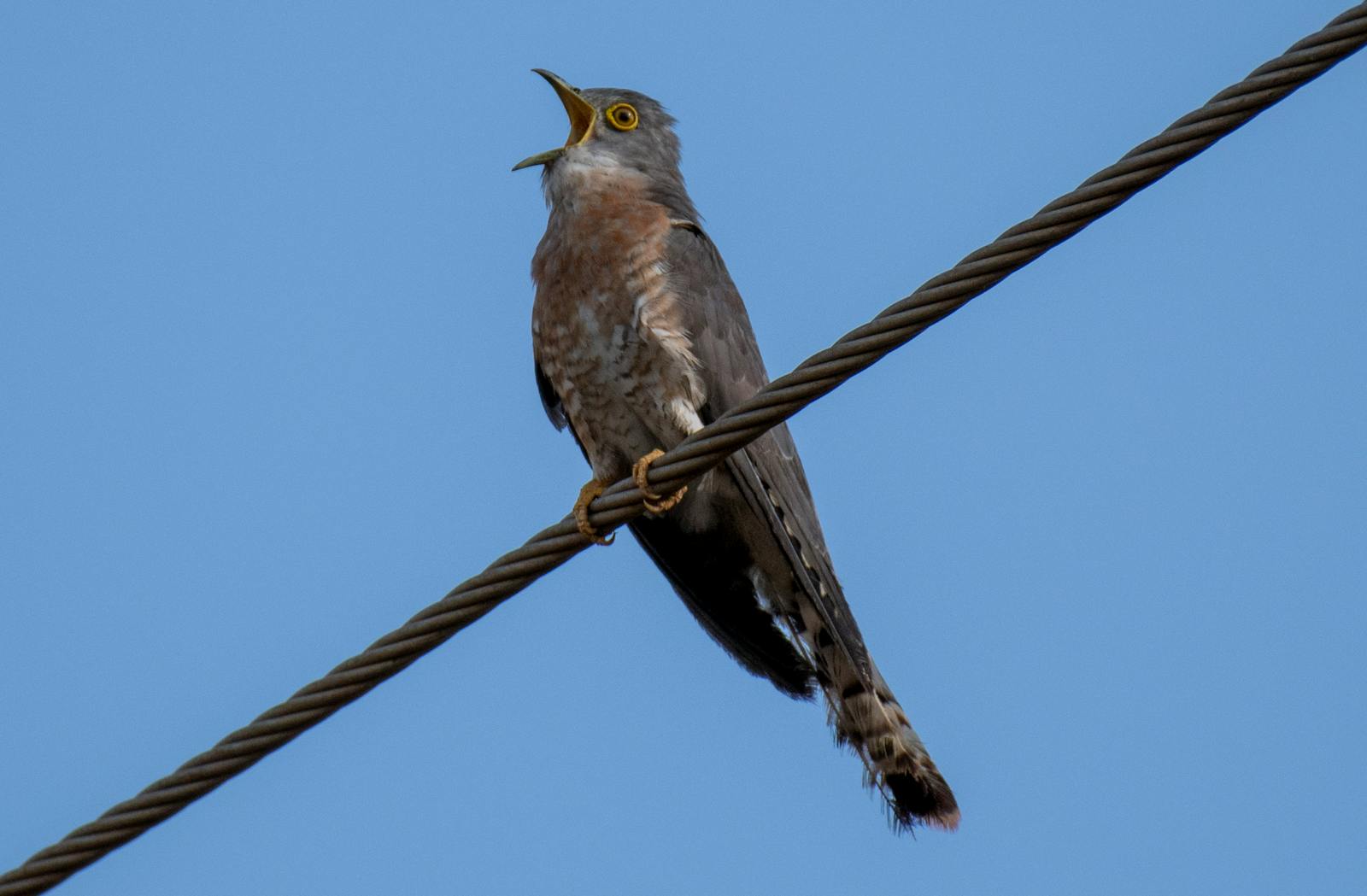
Feature image by Rajukhan Pathan on Pexels