

My father’s last day of work was a Friday in October. He came home with a cardboard box — the cliché kind, with a desk plant and a framed photo of us at Yellowstone — and set it on the kitchen table like it was someone else’s problem. He’d worked thirty-one years as a mechanical engineer for a firm in Columbus, Ohio. He was sixty-two. He had savings. He had a pension. He had a spreadsheet — I’m not exaggerating — a literal spreadsheet mapping out the first year of retirement, week by week, with color-coded categories: travel, exercise, reading, home projects, “social.” The social column was the thinnest.
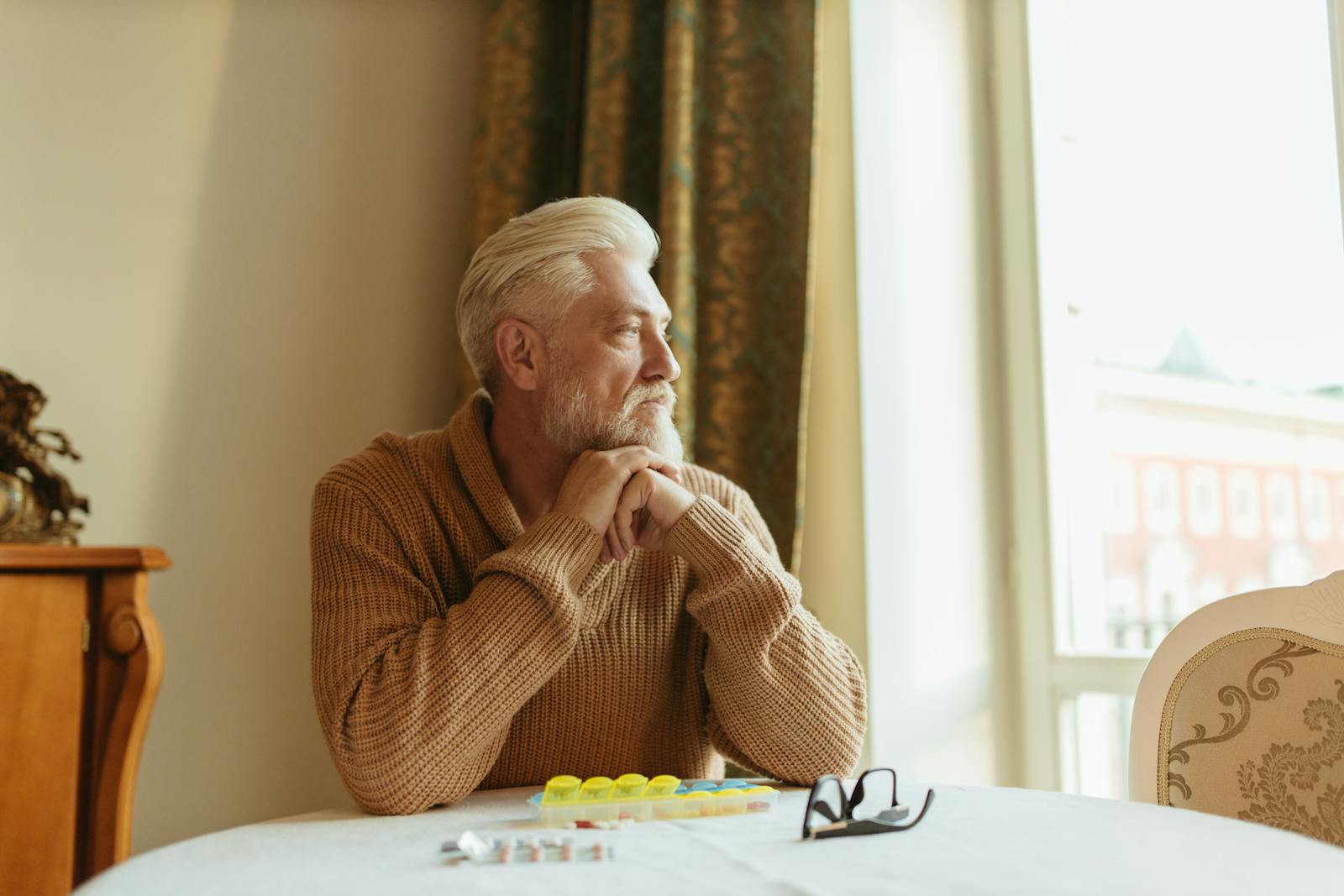
By Thanksgiving, the spreadsheet was gone. Not deleted — just never mentioned again. My mother told me on the phone, her voice low like she was reporting a symptom: “He’s just sitting there, Rachel. He gets up, makes coffee, and sits.”
I thought it was depression. My sister thought it was boredom. My mother thought it was stubbornness — that he refused to try the things he’d planned. But when I flew home in January and actually asked him what was wrong, he said something that rearranged how I think about retirement, purpose, and the terrifying architecture of a life built on being useful.
“Nobody needs me to do anything,” he said. “Not a single person on earth is waiting for me to show up.”
He wasn’t sad about having free time. He was devastated by the absence of obligation.

There’s a concept in psychology called mattering — the feeling that you are significant to other people, that your presence or absence would be noticed. It’s distinct from self-esteem, which is about how you evaluate yourself. Mattering is about how the world evaluates you — or more precisely, how you believe the world evaluates you. Researchers at the University of British Columbia have found that perceived mattering is one of the strongest predictors of psychological well-being in older adults, outperforming income, physical health, and even marital satisfaction in some longitudinal models.
My father didn’t lack things to do. He lacked things that would go undone if he didn’t do them.
I’ve been thinking about this distinction constantly since we explored the retirement crisis nobody talks about — the slow psychological collapse of men who built their entire identity around being needed. The responses to that piece were staggering. Hundreds of readers — mostly women, mostly wives — writing in to say: this is my husband. This is what happened to us.
Gerald, a sixty-seven-year-old former logistics manager in Tampa, emailed to say he’d started volunteering at a food bank three days a week just so someone would be “counting on him to show up at 7 AM.” It wasn’t about altruism, he admitted. It was about the feeling he got when the coordinator texted him the night before: See you tomorrow, Gerald. That text — five words — was doing the psychological work that three decades of project deadlines used to do.
Diane, fifty-nine, a recently retired pediatric nurse in Minneapolis, described something similar but inverted. She didn’t lose her sense of mattering when she stopped working — she lost it when her youngest daughter stopped calling for advice. “She used to phone me about everything — fevers, recipes, fights with her husband. Then one day she just… figured it all out. I should’ve been proud. Instead I felt like a library that nobody visits anymore.”
This is the cruel geometry of mattering: it requires someone else’s need. You can’t manufacture it alone. You can’t find it in a hobby or a book club or a trip to Portugal — not really. As one reader described after quitting his career and buying the house on the lake, the emptiness wasn’t about scenery or schedule. It was about disappearing from the social ecosystem that once depended on you.
I call this purpose dependency — the state in which your psychological stability is structurally reliant on other people’s demands. It’s not codependency, which implies dysfunction. Purpose dependency is arguably how most functional adults operate for forty years. Your kids need rides. Your boss needs reports. Your spouse needs you to fix the sink, make the appointment, remember the anniversary. These aren’t burdens — they’re load-bearing walls. Pull them out and the house doesn’t feel lighter. It sways.
What makes this especially disorienting is that we spend decades fantasizing about the removal of exactly these obligations. The retirement dream — as sold by financial planners and beach-town billboards — is a life with no demands. Finally, you can do what you want. But “what you want” is a question that presumes a stable self underneath all the roles. For many people — especially men who came of age in eras when identity and occupation were nearly synonymous — there is no self underneath the roles. The roles are the self.
A 2020 study in The Journals of Gerontology found that involuntary retirement increased the risk of depressive symptoms by 40%, but — and this is the part that haunts me — voluntary retirement increased the risk by nearly 20% as well. Choosing to leave didn’t protect people. The mechanism wasn’t about control. It was about the sudden evaporation of structured social necessity.
My father had control. He had choice. He had money. None of it mattered because the thing he actually lost — the thing no spreadsheet could replace — was the experience of being load-bearing in someone else’s life.
I wrote recently about a woman who watched her husband become unrecognizable within months of retirement, and one phrase from her story keeps circling back: “He didn’t lose his job. He lost the version of himself that people relied on.” That’s the distinction most retirement planning completely misses. We plan for income replacement. We don’t plan for identity replacement — which is really mattering replacement.
Marcus, a seventy-one-year-old former school principal in Raleigh, told me he finally understood this when his wife handed him a grocery list and said, “I need you to get these by four o’clock because the neighbors are coming.” He said he felt a rush — an actual physiological lift — from having a task with a deadline and a social consequence. “I nearly cried in the cereal aisle,” he said. “Over a grocery list.”
It wasn’t the errand. It was the structure of being needed — the implicit message that his action would affect someone else’s experience. That someone was counting on him.
Some people find their way through this. Gerald has his food bank. Diane eventually started mentoring new nurses at the hospital she left — not for pay, but because trainees would text her at 11 PM asking what to do about a difficult parent, and those texts were oxygen. Even research on midlife bird watching suggests that what looks like a simple hobby may actually be the brain seeking a particular kind of engaged attention — a sense of being in relationship with something that requires your presence.
But I don’t want to wrap this in a bow. Because the deeper reality — the one my father eventually helped me see — is that the problem isn’t solvable in the way we want it to be. You can’t engineer mattering. You can create conditions for it. You can show up at the food bank. You can offer to mentor. You can answer the phone when your daughter calls about the fever. But you cannot make someone need you. And the people who struggle most in retirement aren’t the ones who fail to find hobbies. They’re the ones who finally understand — maybe for the first time — that being needed was never something they earned. It was something the structure of working life provided, automatically, without anyone naming it.
My father is sixty-five now. He tutors eighth-graders in math at a community center on Tuesdays and Thursdays. He joined a men’s group at his church — something he would have scoffed at five years ago. He still has mornings where he sits with his coffee and stares at nothing. But he told me last month that a kid named Jaylen had asked if he’d be there next Tuesday, and my father said yes, and then — I could hear it in his voice — that small promise held him upright for the rest of the week.
Not the math. Not the teaching. The fact that someone, somewhere, would notice if he didn’t show up.
That’s what we lose when we stop working. Not the paycheck. Not the routine. Not even the sense of accomplishment. We lose the daily, unconscious proof that our absence would create a gap. And the terrifying freedom of retirement — the freedom every working person envies — is really the freedom to discover whether you exist when nobody’s asking you to.
Feature image by – landsmann – on Pexels