
In a small office in eastern Caracas, a logistics company owner recently described how she spent three years routing payments for imported auto parts through a chain of four intermediary banks spanning Panama, Colombia, and Miami, paying fees at every stop that consumed nearly 15 percent of each transaction’s value. Her company’s Venezuelan bank accounts were useless for international transfers. The U.S. financial system, and every bank that touched it, had been walled off. When word reached her in recent weeks that certain correspondent banking channels were quietly reopening, she did not celebrate. She asked the question that every Venezuelan business owner in her position asks: what does Washington expect in return?
That question captures the psychology of sanctions relief more accurately than any policy brief. The United States has been quietly loosening banking sanctions on Venezuela at the very moment the Maduro government faces its most sustained wave of domestic unrest in years. Reports indicate that Washington has eased restrictions on certain Venezuelan financial institutions, a move that arrives against a backdrop of deepening economic crisis, street protests, and a regime scrambling to keep its grip on both currency flows and political legitimacy. The timing is not coincidental. It rarely is.
Sanctions, in the way most people understand them, are punishment. They are framed as economic pressure meant to change a government’s behavior. But the decision to ease them is never purely about reward, either. It is a recalibration of leverage, an admission that the existing pressure configuration has stopped producing the desired effect, or that a new configuration might extract something more valuable.
The Venezuelan situation is a case study in what analysts have described as sanctions fatigue. U.S. financial restrictions on Caracas were layered on during the Trump and Biden administrations, designed to choke off revenue to the Maduro government and force political concessions, primarily around free elections and the release of political prisoners. The theory was straightforward: deny the regime dollars, and it would eventually bend.
It didn’t bend. It adapted.
The Maduro government has reportedly pivoted to alternative economic mechanisms, including gold sales and cryptocurrency experiments, while developing reliance on intermediaries in countries less aligned with U.S. sanctions policy. The people who suffered most were not senior regime figures but ordinary Venezuelans, whose daily economic life became a maze of workarounds. The sanctions did real damage to the Venezuelan economy, but that damage fell disproportionately on the private sector and the population at large.
Former banking compliance officers who worked in Caracas have described the sanctions regime as incomplete and ineffective, noting that regime-connected elites always found channels despite restrictions. What the sanctions did accomplish was the systematic destruction of the formal banking infrastructure that ordinary businesses depended on.
This is the paradox that Washington is now trying to manage. The easing of bank sanctions comes alongside reported contacts involving Delcy Rodríguez, Venezuela’s executive vice president, who has served as a key negotiator with Western governments. Rodríguez occupies a particular position in the regime’s architecture: she is both a true believer and a pragmatist, someone who has shown willingness to engage with Washington when the terms suit Caracas.
The psychology of this kind of negotiation is distinct from ordinary diplomacy. Sanctions relief operates on what behavioral economists recognize as a variable reinforcement schedule. The target government never knows precisely when relief might come, or in what form, which keeps it perpetually engaged in signaling compliance (or the appearance of compliance) without actually committing to structural change. Washington, for its part, can calibrate the easing to extract specific concessions, such as the release of particular prisoners or the granting of certain oil licenses, without conceding the broader point that the sanctions themselves may not be working.
But the real engine driving this recalibration is not Venezuelan behavior. It is American domestic politics. With immigration remaining a charged issue and Venezuela being a major source of asylum seekers arriving at the U.S. southern border, Washington has a concrete incentive to stabilize the Venezuelan economy just enough to slow the outflow of people. The gap between the stated objective — a democratic Venezuela — and the operational goal — a slightly more stable Venezuela that sends fewer migrants north — is the space where sanctions policy actually lives. The official goals provide the moral framework. The operational goals are much smaller, much more pragmatic, and much less satisfying to say out loud.
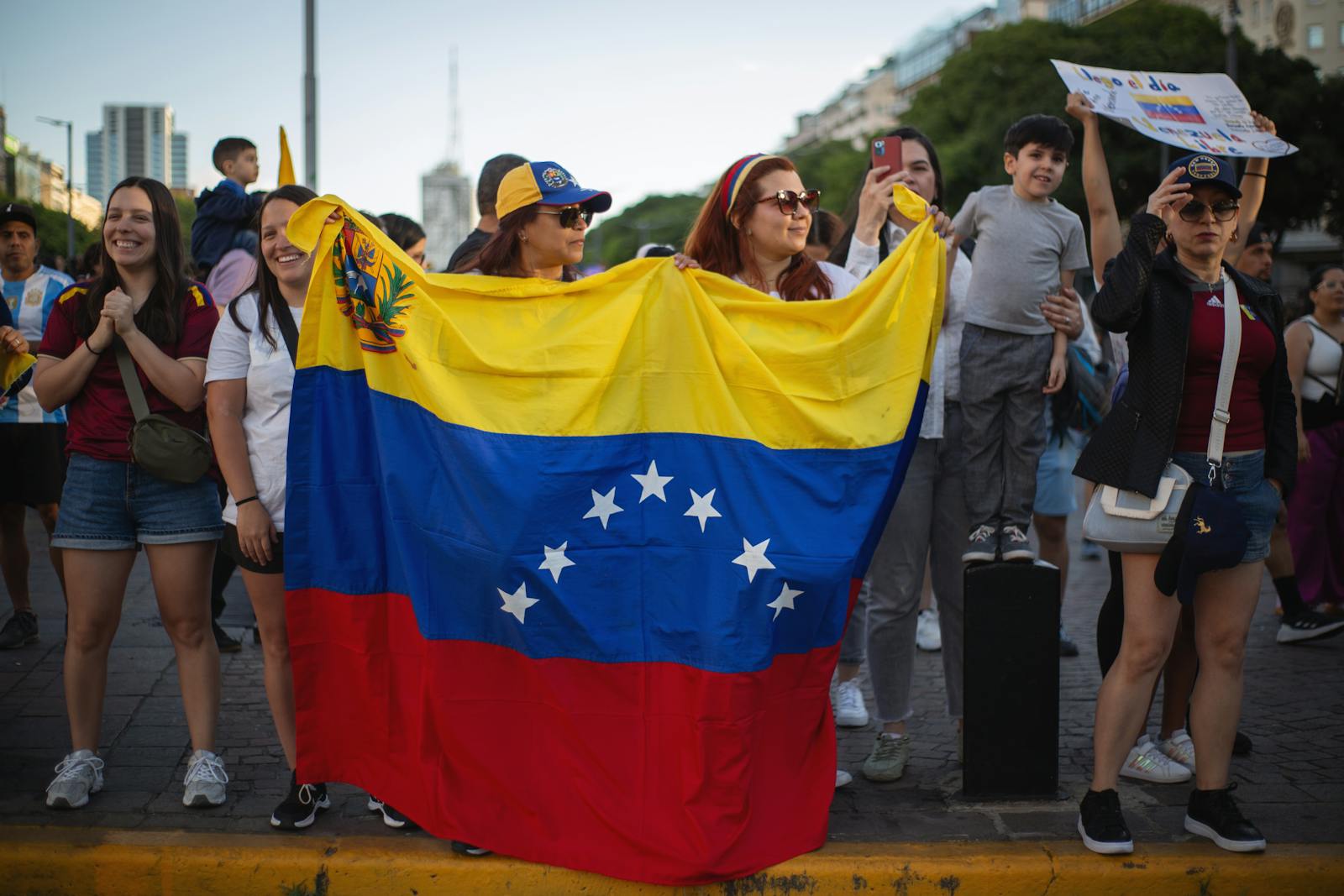
This is where the geopolitics meets the street. The protests that have flared across Venezuelan cities in recent months are driven by a population that has endured years of hyperinflation, shortages, and economic contraction. The bolivar, Venezuela’s currency, has reportedly been functionally replaced by the U.S. dollar in much of daily commerce, a development that the Maduro government has tacitly accepted because it has no alternative. Easing bank sanctions, in this context, doesn’t just help formal businesses process transactions. It also increases the flow of remittances from the Venezuelan diaspora, money that directly reaches families and functions as a kind of informal social safety net.
Every dollar that flows more easily into Venezuela through legal banking channels is a dollar that might keep someone from joining a caravan heading north. The humanitarian framing and the immigration-control framing point in the same direction, which is politically convenient for an administration that needs wins on both fronts.
But the calculation is also fragile. Small logistics operators have pointed out that the businesses most likely to benefit from sanctions easing are those with existing relationships to international banks, meaning firms that are larger, better connected, and often closer to the regime’s orbit. Small operators may find that the reopening of banking channels simply concentrates more economic power in the hands of those who already have it.
This is a pattern that appears to have repeated across sanctions-relief episodes in recent decades. The first beneficiaries of re-engagement are often the incumbents, the established players who have the infrastructure and relationships to move quickly. The diffusion of benefits to the broader economy takes months or years, and in unstable political environments, it often never happens at all because the regime captures the new flows before they can reach the general population.
Banking experts have compared it to opening a faucet in a house with corroded pipes. The water flows, but it comes out brown and goes to the rooms closest to the source. The back rooms stay dry.
The broader pattern of U.S. engagement with Latin American leaders reveals something consistent: Washington’s approach to the region oscillates between punitive isolation and transactional engagement, with very little sustained strategic investment in between. Venezuela has been subject to extensive financial sanctions, and the results, measured against the stated objectives of regime change or democratic transition, have been close to zero. Maduro remains in power. Elections remain contested. Political prisoners remain in custody, with periodic releases timed to coincide with sanctions negotiations.
What has changed is not Maduro’s behavior but Washington’s assessment of its own leverage. The easing of bank sanctions is an implicit acknowledgment that maximum financial pressure did not produce the desired political outcomes. It is not a concession to Maduro so much as a concession to reality.
Some researchers have identified a cognitive bias in which policymakers persistently believe that additional pressure will finally produce the desired outcome. Each new round of sanctions was presented as the measure that would tip the balance. Each round failed to do so, but the framework prevented policymakers from admitting that the tool itself might be mismatched to the objective.
The protests now roiling Venezuelan cities add a new variable. Domestic unrest gives both Washington and Caracas reasons to deal. For Maduro, sanctions relief provides a release valve, more dollars flowing through the banking system means slightly less economic misery, slightly less fuel for the protests. For the U.S., easing sanctions while protests are ongoing allows Washington to frame the move as supporting the Venezuelan people rather than rewarding the regime. The optics are manageable, at least for now.
Delcy Rodríguez’s involvement in these discussions is itself a signal. Rodríguez, who has been personally sanctioned by the European Union and has faced travel restrictions in multiple jurisdictions, represents the regime’s willingness to put a senior figure at the table. She is not a back-channel intermediary. She is the regime’s public face in negotiations, which means Maduro wants the world to know that he is engaging, even if the substance of that engagement remains thin.
For the millions of Venezuelans who have left the country since 2015, the sanctions easing registers somewhere between hope and cynicism. Venezuelan workers abroad who send money home to family members have used informal money transfer services that charge steep fees because the banking system was effectively broken. If the sanctions easing means they can use normal bank transfers, they will save money each month. That is not nothing. But it does not change the underlying reality that drove them to leave.
And this is the dimension that policy discussions about sanctions rarely touch. The human cost of sanctions is diffuse, cumulative, and largely invisible in the policy calculus. The human benefit of sanctions relief is similarly diffuse. People save money on transaction fees. Businesses might reduce their payment processing costs. But the structural damage remains.
The structural reality is that sanctions are a blunt instrument being used for precision work. They are designed to change government behavior, but they operate by changing the economic conditions of entire populations. The gap between the target and the impact zone is enormous. Easing them does not close that gap. It simply adjusts the shape of the economic pain.
What Washington is doing with Venezuela right now is not a new strategy. It is the same strategy with a different setting on the dial. The pressure has not worked at maximum, so the administration is trying it at medium, hoping that the combination of partial relief and partial threat will produce concessions that full pressure could not. This is rational. It is also familiar. It is the pattern that has governed U.S. sanctions policy toward every authoritarian government for the past three decades.
Venezuelans will send their next remittances through whatever channel is cheapest. Business owners will reroute their payment flows if the numbers work. Maduro will remain in Miraflores. And the U.S. will describe the sanctions adjustment as a calibrated response to evolving conditions, which is the diplomatic way of saying that the old approach failed, and the new one is a bet on something slightly less ambitious. Washington will call it strategic flexibility. Caracas will call it a victory. And that logistics company owner in eastern Caracas will still be paying intermediary fees, just maybe a few percent less, while the regime that sanctions were supposed to unseat continues to operate on the other side of the same banking system.
Sanctions are not a scalpel. They are not even a hammer. They are a thermostat in someone else’s house, and the person inside has learned to wear a coat.