
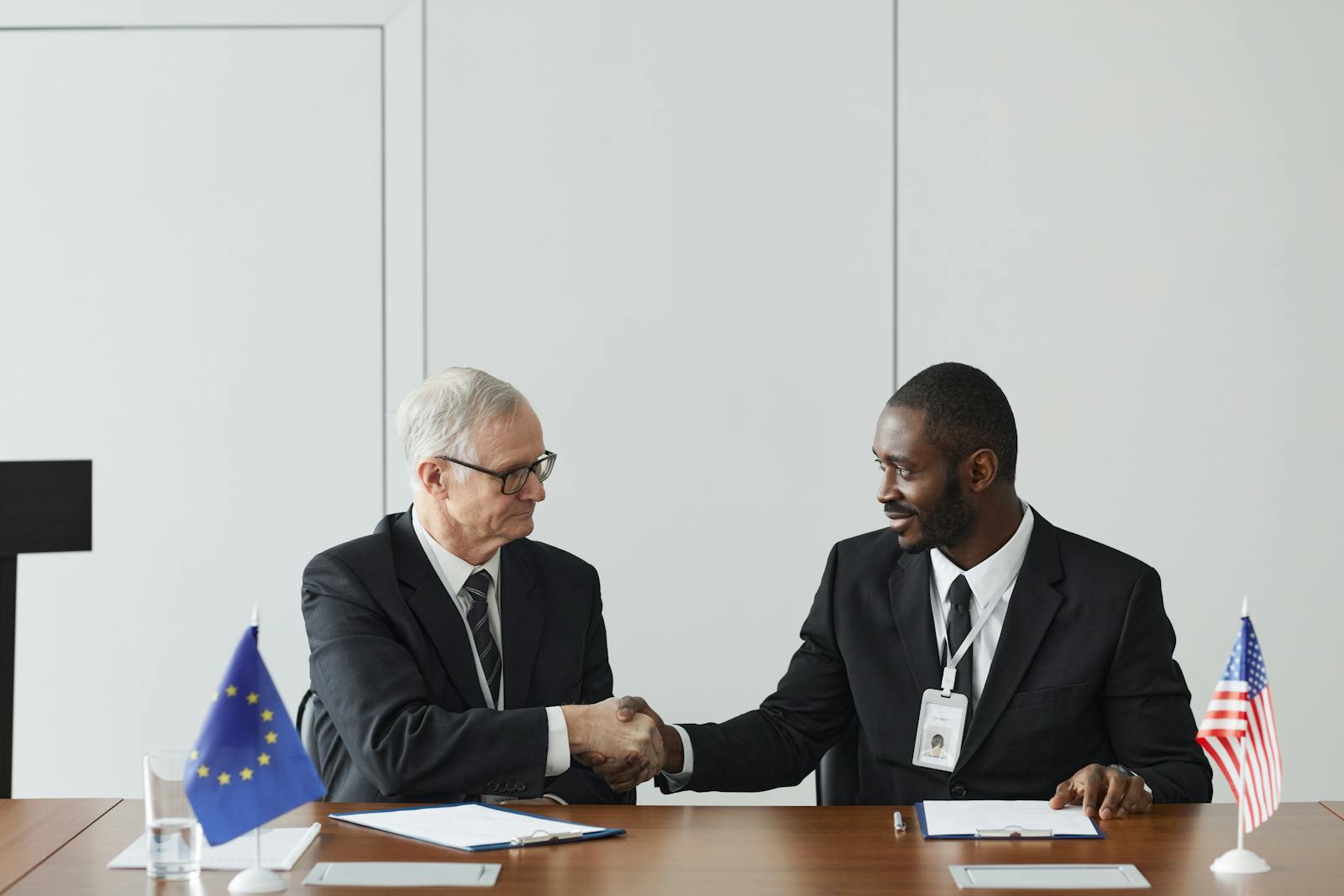
Ayatollah Ali Khamenei has spent four decades building a political identity around resistance to the United States, and sometime in early 2026, he authorized a diplomatic channel that amounts to a quiet concession to an American president he has publicly called a bully. Both facts are true at once. The tension between them tells you more about the nature of power than either fact alone.
Observers of Iranian politics watched the early signals with practiced skepticism. When Axios reported the outlines of a truce between Iran’s supreme leader and the Trump administration, analysts noted they weren’t surprised by the agreement itself. The surprise was that Khamenei let it become visible. For a leader who has spent his entire tenure curating an image of ideological purity, allowing the world to see him deal with Trump was the real news.
The mechanics of how the two sides reached this point involve a familiar cast of intermediaries and a less familiar willingness, on both sides, to lower the rhetorical temperature enough to let back-channel communication survive. Oman, which has historically served as the quiet room where Iranian and American officials can speak without the cameras, played its usual role as interlocutor, though its ability to manage the process was reportedly strained by the administration’s preference for public ultimatums over private patience.
What emerged was not a peace deal. Not a nuclear agreement. Not even a formal memorandum. It was a truce, in the oldest and most literal sense: an agreement to stop escalating, with the understanding that escalation serves neither side’s interests at this particular moment.

To understand why Khamenei moved, you have to understand what psychologists call loss framing. People are far more motivated by the fear of losing what they have than by the prospect of gaining something new. Iran’s economy, battered by sanctions reinstituted and tightened under the second Trump administration, had reached a point where the regime’s domestic stability was genuinely threatened. Not by revolution. By erosion. By the slow bleed of a currency that had experienced significant devaluation and an educated middle class that had stopped believing official explanations.
Small business owners in Iran, particularly those involved in export trade, have felt the impact of sanctions acutely. Every time tensions spike with America, shipping costs increase and European buyers become harder to reach. For these businesses, the truce isn’t about nuclear centrifuges. It’s about whether they survive another year. There are millions facing these pressures, and they represent the kind of pressure that doesn’t show up in satellite imagery of enrichment facilities but absolutely shows up in the supreme leader’s internal polling.
On the American side, the calculus was different but structurally symmetrical. Trump’s second term has been defined by a doctrine of maximum pressure followed by deal-making, a pattern visible across trade policy, NATO negotiations, and now Iran. The administration had pushed sanctions to a level that made further tightening yield diminishing returns. More pressure wasn’t producing more compliance. It was producing more Iranian enrichment activity, more proxy aggression, and more risk of the kind of incident that could spiral into a military confrontation nobody in the White House actually wanted.
Strategic studies experts have been modeling U.S.-Iran escalation scenarios for years. The pre-truce period has been described as a classic example of what game theorists call a mutual hurting stalemate. Both sides had reached a point where continuing to escalate was more costly than finding some off-ramp, but neither side could afford to be seen as the one who blinked first.
The solution, according to strategic analysis, was structural ambiguity. The truce, as reported, contains enough vagueness that both sides can claim they got what they wanted. Khamenei can tell his hardliners that he made no concessions on Iran’s sovereign rights. Trump can tell his base that maximum pressure worked and Iran came to the table. Both narratives are partially true. Neither is complete.
This is the political psychology of face-saving, and it operates the same way whether you’re looking at international diplomacy or a couple arguing about whose turn it is to do the dishes. The substance of the agreement matters less than the story each party tells about it. The psychology of how nations escalate toward conflict has a mirror image: the psychology of how they de-escalate. And de-escalation almost always requires a shared fiction, a narrative loose enough to accommodate contradictory interpretations.
The most revealing detail in the Axios report is not what the truce contains but how it was communicated. Khamenei did not issue a public statement. He did not appear on state television. The signal was allowed to leak through intermediaries and then confirmed obliquely through diplomatic channels. This is how authoritarian leaders manage ideological contradictions: through indirection. The message reaches the people who need to hear it without forcing the leader to own it in a way that could be used against him domestically.
Trump, by contrast, operated in his characteristic mode of maximum visibility. The truce was framed almost immediately as a victory for his negotiating style, a confirmation that strength produces results. The asymmetry in communication style is itself meaningful. It reveals the different audiences each leader is managing and the different risks they face. Khamenei risks appearing weak to hardliners in the Islamic Revolutionary Guard Corps. Trump risks appearing indecisive to a base that expects dominance.
Conflict resolution specialists who have studied back-channel diplomacy between adversarial states point out that truces of this kind are inherently unstable. They depend on a shared assessment of costs that can change overnight. An incident in the Strait of Hormuz, a provocative missile test, a domestic political crisis in either country, any of these could collapse the arrangement within weeks. The truce is not a building. It’s a tent.
Experts also note something less obvious: the truce’s survival depends on mid-level officials on both sides who have a professional interest in making it work. In Tehran, this means a network of Foreign Ministry bureaucrats and IRGC pragmatists who understand that their personal fortunes improve in a less volatile environment. In Washington, it means State Department career staff and intelligence professionals who have been managing the Iran file for years and see the truce as a rare window to reduce operational risk.
This is the unglamorous reality of international agreements. They are sustained not by the leaders whose names appear on them but by the thousands of functionaries who implement them daily. When those functionaries believe in the arrangement, it holds. When they don’t, it unravels from the inside, long before anyone issues a public statement of withdrawal.
Some analysts compare this to the Iran-Contra era, though a potentially better comparison may be the series of informal understandings between the U.S. and the Soviet Union during the late Cold War, arrangements that were never codified in treaties but that both sides respected because the alternative was too dangerous. These arrangements worked precisely because they were informal. Formality would have required each side to acknowledge compromises that were politically impossible to admit.
Analysts argue that the truce’s informality is its greatest strength and its greatest vulnerability. Strength because it allows both sides to maintain their public postures while quietly reducing the risk of confrontation. Vulnerability because informal arrangements have no enforcement mechanism. There is no treaty to violate, no international body to appeal to, no legal framework to invoke. If one side decides to walk away, the other has no recourse except to escalate again.
There’s a broader lesson embedded in this. The international system has been slowly shifting away from formal agreements and toward these kinds of ad hoc arrangements for years. The collapse of the original JCPOA under Trump’s first term, the failure of various arms control treaties, the erosion of multilateral frameworks across the board have all pushed diplomacy into a more transactional, personality-driven mode. Whether you think this is healthy depends largely on whether you trust the personalities involved. And that trust, by definition, is temporary. Leaders leave. Arrangements built on personal rapport leave with them.
For ordinary Iranians involved in trade and commerce, the practical effects are immediate. European clients have started responding to emails again. The rial has shown some stabilization. Business owners and their employees, who depend on these enterprises for their families’ income, are less anxious than they were six months ago. The truce, for those on the ground, is a weather forecast. Things have cleared up. Many do not trust that the weather will hold.
Strategic analysts put it in more clinical terms. The mutual hurting stalemate produced a temporary equilibrium. Both sides have stepped back from the edge. But the underlying conditions that created the stalemate haven’t changed. Iran still wants regional influence and a nuclear hedge. The United States still wants to contain that influence and prevent a nuclear weapon. Nothing about those fundamental positions has shifted. The truce addresses the symptoms, not the disease.
This is where decades of U.S. policy toward adversarial states offer a cautionary lesson. Pressure campaigns can produce tactical concessions. They rarely produce strategic transformations. Cuba’s government survived sixty years of embargo. Iran’s regime has survived forty years of sanctions of varying intensity. The assumption that economic pain translates directly into political change underestimates the capacity of authoritarian systems to redirect blame outward and absorb domestic suffering as a cost of ideological survival.
Experts describe the truce as a managed pause. Both sides are using the breathing room to reposition. Iran is using it to stabilize its economy just enough to reduce domestic pressure. The U.S. is using it to free up diplomatic and military bandwidth for other priorities. Neither side views the truce as an end state. It’s a tactical respite in a longer competition.
The question that matters is not whether the truce will hold permanently. It won’t. Informal arrangements between adversaries never do. The question is what both sides do with the time it gives them. If Iran uses the pause to quietly advance its nuclear program, the next confrontation will be worse than the last. If the U.S. uses it to build a broader coalition for a more sustainable containment architecture, the next round of negotiations might start from a stronger position. The truce creates a window. What matters is what gets built inside it.
Those who have followed Khamenei’s rhetoric over the years note that it hasn’t changed. The sermons still invoke the struggle against American arrogance. But now there is this quiet accommodation running underneath the words, a recognition that survival sometimes requires doing the thing you swore you would never do. Those who lived through the Iran-Iraq war understand the contradiction perfectly. They know that survival is not glamorous. It’s just necessary.
Khamenei is 86 years old. His time horizon is finite. The truce with Trump may be less about strategic vision than about the instinct of an aging leader who wants to leave behind something other than a country in economic free fall or, worse, a country at war. That’s not the story that will be told on Iranian state television. But it may be the truest one.
Power doesn’t announce its compromises. It absorbs them quietly, reshapes the narrative to make concession look like strategy, and moves on. The truce between Khamenei and Trump is not a triumph of diplomacy or a capitulation by either side. It is what happens when two leaders, each trapped inside their own mythology, discover that reality has a veto.