
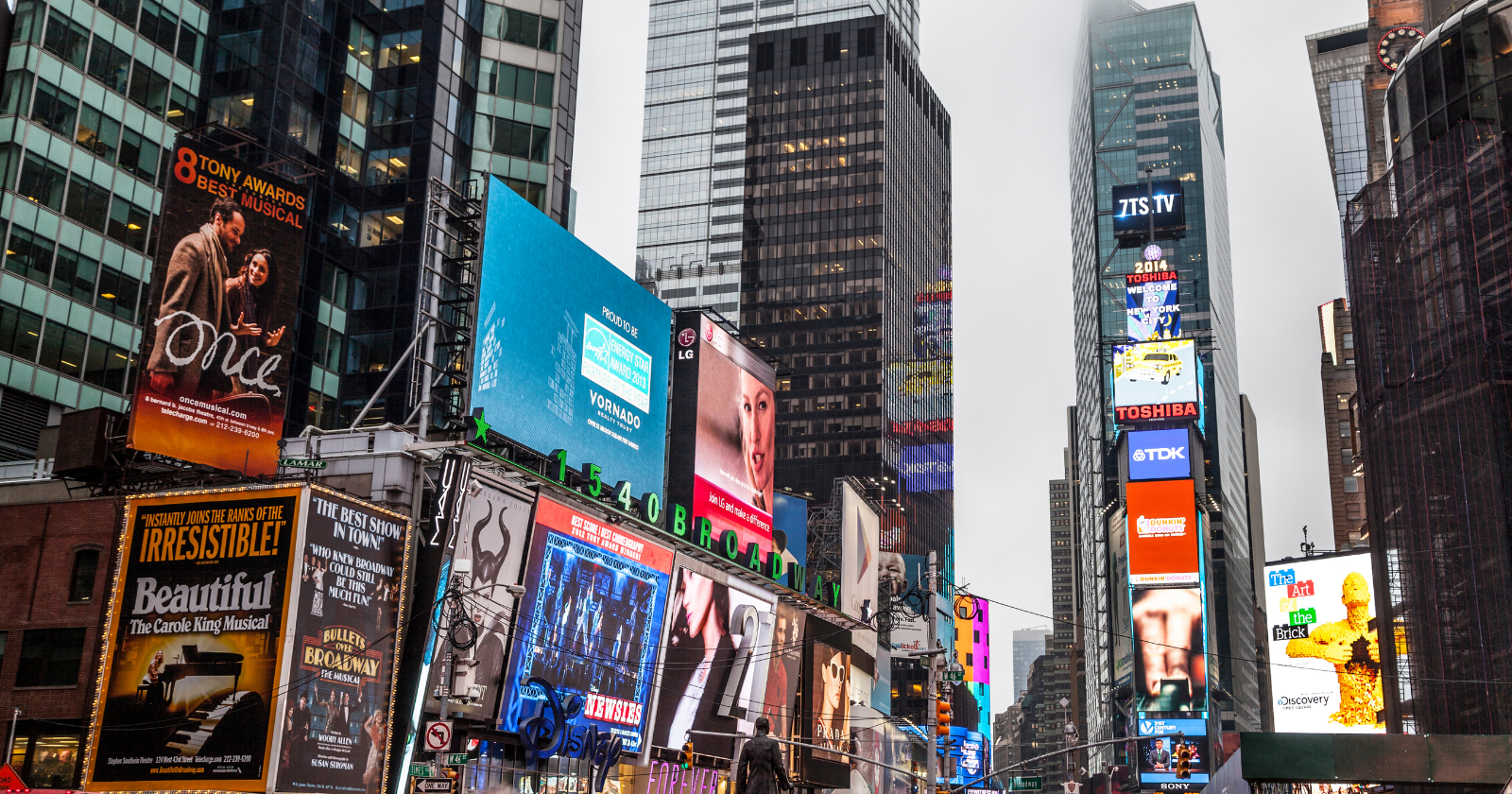
A billboard is a river stone. It has sat in the same current for more than a century, weathered by traffic, weather, and taste, while repeated attempts to replace it with something sleeker have failed to remove it from the media landscape. What has changed is what can be built around it. Static vinyl now exists alongside LED displays, sensors, sound, scent, and digital layers delivered through phones or wearable devices.
That quiet inversion is the story of out-of-home advertising in 2026.
InternetRetailing reported, citing eMarketer, that US out-of-home spending surpassed $9 billion for the first time in 2024. It also cited a Statista projection placing global OOH spending at $41.82 billion in 2025. Survey data from the OOH agency Excite OOH, referenced in the same article, found that 80% of respondents reported making a purchase after seeing an outdoor ad and 77% said they discovered new brands or products through outdoor advertising. Those survey figures come from an industry participant and should be read as directional rather than as an independent market benchmark.
One catalyst was the 2026 FIFA World Cup, which ran from June 11 to July 19 across the United States, Canada, and Mexico, according to FIFA’s published schedule. Before the tournament, a January 2026 InternetRetailing analysis described preparations involving digital billboards, transit ads, immersive fan-zone displays, real-time updates, AR features, and interactive content. Its references to Times Square, stadium concourses, motion-sensitive installations, and live-score displays were forward-looking examples of what advertisers were preparing or testing, not a post-event record of specific completed installations in Toronto or Mexico City.
The deeper shift is that a physical surface once bought primarily for reach can now carry a second payload: social sharing, location-level measurement, branded search, or interaction through a connected device. Elliot Ward of Excite OOH told InternetRetailing that his agency had observed multisensory activations producing three to four times more audience interaction than standard digital or static boards. That figure is an agency observation rather than an independently published industry benchmark, but it captures the commercial logic behind these experiments.
The category also fits a business climate that has become more suspicious of ad-tech’s promises. Attribution remains contested, browser-based identifiers have become less dependable, and the use of precise location information faces mounting scrutiny. In its June 29, 2026 decision in Chatrie v. United States, the US Supreme Court held that police conduct a Fourth Amendment search when they obtain a person’s Google Location History data. The ruling concerned law enforcement rather than advertising, but it underscored how sensitive location records have become.
A painted wall does not rely on browser cookies and cannot be skipped by an ad blocker. It is not beyond regulation, however. Outdoor advertising remains subject to local planning and advertising rules, while sensor-based measurement and mobile targeting can introduce their own privacy questions.
Which brings the story to Snap.
On June 16, 2026, CEO Evan Spiegel used the Augmented World Expo stage to unveil the company’s next-generation Specs, priced at $2,195 with a $200 refundable deposit, according to MediaPost. The wireless glasses come in two sizes weighing 132 and 136 grams and offer a 51-degree field of view through Snap’s proprietary liquid-crystal-on-silicon display. Snap says its redesigned waveguide uses billions of tiny nanostructures. Separately, the glasses’ electrochromic lenses were inspired by technology used in Boeing 787 Dreamliner windows. Shipments were scheduled for fall 2026 in the United States, United Kingdom, and France.
Spiegel’s positioning echoes Meta CEO Mark Zuckerberg’s argument that less intrusive smart glasses may eventually replace some smartphone functions by processing visual, audio, motion, and contextual information. There is also a more immediate business reading. Spiegel’s September 2025 open letter presented Specs as a way for Snap to move beyond the limits of smartphones and crowded competition, making the product an important strategic test for the company.
The interesting question is not whether Specs will outsell Meta’s Orion or Apple’s Vision products. It is what happens to physical advertising if even a small share of urban pedestrians begins wearing glasses capable of rendering digital information over a billboard, shopfront, or transit display.
This stacking model is more modest than earlier promises of an AR revolution, but it may prove more consequential. The advertising industry has discussed heads-up-display marketing since the Google Glass era. What is now becoming plausible is a physical placement designed to trigger several connected experiences instead of carrying one fixed message.
Earlier campaigns show how that logic can work even without widespread AR glasses. Splash PR reported that Puma installed four dynamic 3D billboards in South Africa in 2024, each featuring Jack Grealish. The wider campaign extended across social media, television, public relations, OOH, and points of sale, with athletes including Neymar Jr., LaMelo Ball, and Antoine Griezmann appearing in supporting creative.
Starbucks used another form of sensory layering in 2023. A JCDecaux account of the campaign describes a two-week tunnel takeover at King’s Cross St Pancras in London that added the sound of shaking ice and scent dispensers to an iced-coffee promotion. JCDecaux said the installation was expected to reach 1.3 million people and support 20 nearby Starbucks stores. It did not report a 25% increase in dwell time.
Neither campaign depended on consumer AR glasses, but both treated the physical placement as more than a single visual. The installation became an input to a wider system of sound, movement, social content, and nearby retail activity.
The market has noticed the broader shift toward flexible displays. Market.us forecasts the mobile digital billboard market growing at a compound annual rate of 9.2% from 2025 to 2034. That category specifically covers displays mounted on vehicles such as trucks, vans, and buses, so it should not be treated as a forecast for all fixed digital signage. It is nevertheless one indicator of advertiser demand for physical media that can move, update, and connect with digital campaigns.
This is where OOH begins to look less like an isolated line item and more like campaign infrastructure. The physical placement supplies visibility, while digital systems add changing creative, measurement, interaction, and distribution.
The risk also sits in plain sight. A campaign designed to become a shareable moment can fail publicly as one. Physical media exposes broken displays, badly timed creative, and faulty interactive features to everyone occupying the space, not only to a targeted browser session.
There is also an ownership question. A pedestrian looking directly at a billboard sees the placement purchased from the property or media owner. A pedestrian viewing it through AR glasses may see an additional layer controlled by the device platform. If wearable AR gains meaningful adoption, the right to annotate physical space could become a commercial and regulatory contest involving platforms, advertisers, property owners, and city governments.
What is easy to miss is how conventional the underlying logic remains. Large images in high-traffic locations can still attract attention, while repeated exposure can build familiarity. Sensory context, such as the sound and scent used in the Starbucks tunnel campaign, can make a placement feel like an experience rather than a flat message. The multiplier effect resembles influencer marketing: attention purchased in one place can produce attention earned elsewhere. The physical placement is the seed. The share is the harvest.
The old engagement-marketing playbook captured a similar principle. A physical object can act as a trigger inside a wider digital sequence rather than as a rival to it.
That is what the AR-plus-OOH convergence quietly confirms. Digital advertising has spent years trying to become more contextual, ambient, and connected to the places where people make decisions. Physical media has absorbed many of digital’s tools without surrendering its most basic advantage: it occupies real space. A well-placed wall cannot do everything a display network can do, but it can now trigger digital experiences while remaining physically present after the screen is put away.