
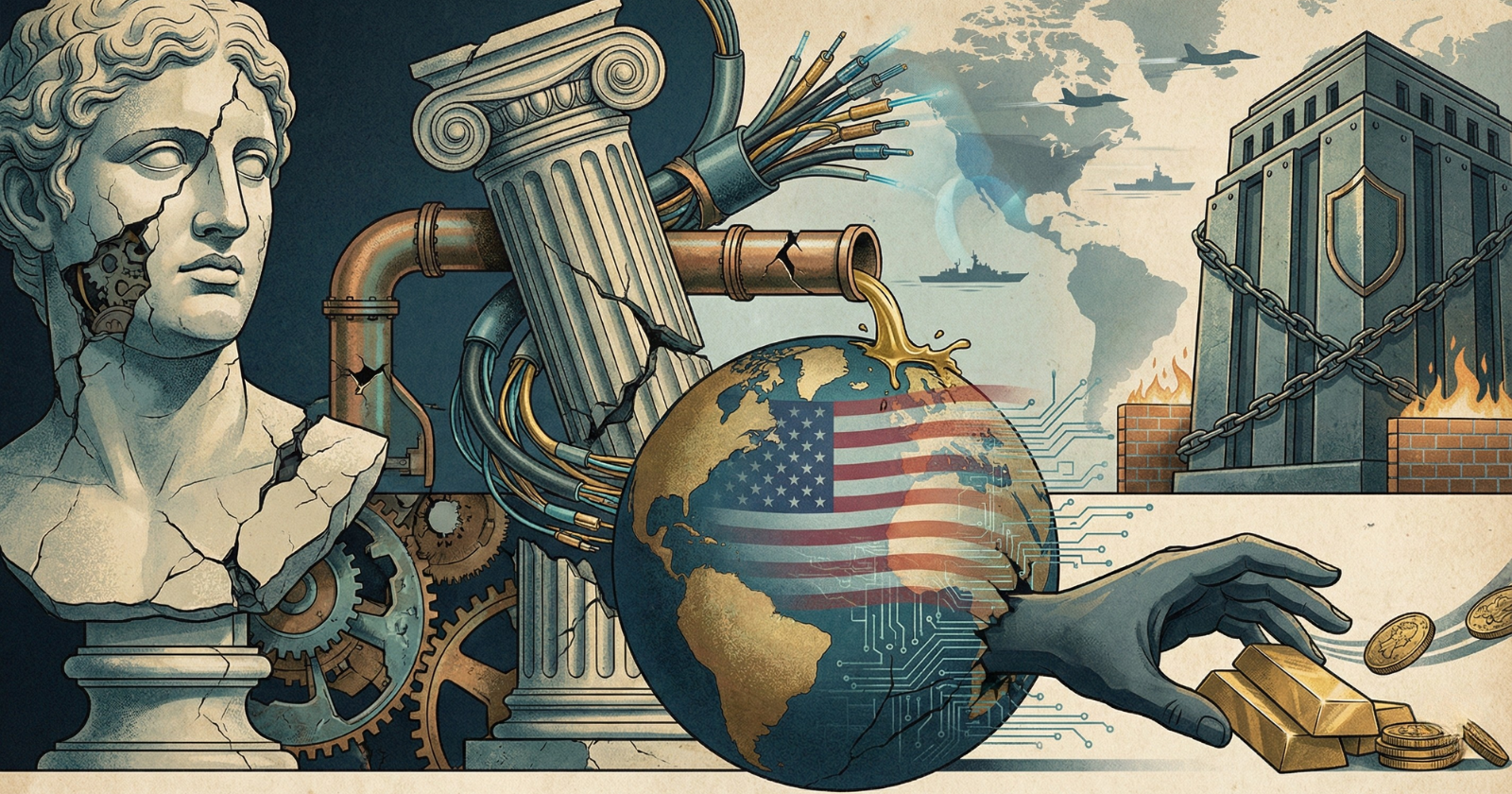
The Venezuela raid isn’t about what the headlines say it’s about. Here’s what they’re not telling you.
On January 3rd, the United States military captured a sitting foreign president, flew him to New York in handcuffs, and announced that America would “run” his country. Within hours, the commentary machine churned out the predictable responses: debates about legality, arguments about democracy, fact-checks on drug trafficking claims.
All of it missed the point.
As I wrote for Silicon Canals this week, the capture of Nicolás Maduro represents something more significant than another U.S. intervention in Latin America. It represents the moment the United States stopped pretending that its foreign policy is about principles—and revealed that it has always been about protecting a very specific privilege.
That privilege has a name. Most people have never heard of it. And understanding it changes how you see not just Venezuela, but the entire architecture of American power.
The tension
Here’s the contradiction at the heart of this story that nobody in mainstream coverage is addressing:
The United States carries $38 trillion in national debt. It pays more than $970 billion annually just in interest—the second-largest federal expense after Social Security. The government spends over $11 billion per week servicing what it already owes.
Any other country with this profile would have collapsed into hyperinflation or default decades ago.
The U.S. hasn’t. Why?
The answer is something called the “exorbitant privilege“—a term coined in the 1960s by French Finance Minister Valéry Giscard d’Estaing to describe the unique advantages that accrue to the country whose currency serves as the world’s reserve.
Because the world needs dollars to buy oil, settle international debts, and participate in global trade, there’s automatic demand for American currency. This demand allows the U.S. government to borrow at lower interest rates than any other nation. It means the U.S. can run permanent deficits, fund its military, and maintain global dominance in ways that would bankrupt any other country.
The foundation of this system was laid in 1974, when Henry Kissinger negotiated an agreement with Saudi Arabia to price oil exclusively in dollars. In exchange for American military protection, the Saudis agreed that the world’s most essential commodity would be bought and sold in American currency. The “petrodollar” was born.
For fifty years, this arrangement has enabled the United States to live beyond its means. And Venezuela threatened to prove it could be undone.
The noise
Listen to the coverage of the Maduro capture and you’ll hear a lot of arguments:
“It’s about drug trafficking.” Maduro was indicted on narcoterrorism charges. The administration invoked these charges as justification for the raid. But fact-checkers have noted that Mexico and Colombia remain far larger conduits for cocaine entering the United States. If drug trafficking were the criterion, the list of leaders to capture would be much longer.
“It’s about democracy.” Maduro did steal an election. He is an authoritarian. But the United States has supported and continues to support plenty of authoritarians who serve American interests. Saudi Arabia’s Mohammed bin Salman ordered the murder and dismemberment of a journalist. Egypt’s Abdel Fattah el-Sisi runs one of the most repressive regimes in the Middle East. The democratic criterion is applied selectively—which means it isn’t really the criterion.
“It’s about regional stability.” Eight million Venezuelans have fled the country under Maduro. The humanitarian crisis is real. But American intervention has rarely produced stability or flourishing in the countries where it occurs. The track record from Guatemala to Iraq suggests something other than humanitarian outcomes.
All of these explanations have some truth in them. None of them explain why this president, this country, this moment.
To understand that, you have to follow the money. Literally.
What was actually threatened
Venezuela sits on 303 billion barrels of proven oil reserves—the largest in the world, exceeding even Saudi Arabia’s. And since 2018, Venezuela had been selling that oil in Chinese yuan, not American dollars.
About 80 percent of Venezuela’s oil exports were going to China. Caracas had established direct payment channels with Beijing that bypassed SWIFT—the U.S.-dominated financial messaging system that Washington has repeatedly weaponized through sanctions. Venezuela had been actively seeking BRICS membership, aligning itself with the economic bloc building alternative payment systems designed to circumvent the dollar entirely.
In other words: a country with the world’s largest oil reserves was proving that you could function outside the American financial system—with Chinese backing.
The historical pattern is unmistakable. In 2000, Iraq announced it would accept only euros for its oil; three years later, Saddam Hussein was removed from power. Libya’s Muammar Gaddafi proposed a gold-backed pan-African currency to replace the dollar for oil transactions; NATO intervened in 2011. Iran has sold oil in currencies other than dollars since 2012 and faces continuous sanctions and threats of military action.
Venezuela is simply the latest chapter. The common thread isn’t democracy, drugs, or human rights. It’s the currency in which oil is priced.
The real stakes
The immediate threat to the dollar wasn’t that Venezuela alone would collapse the system. Venezuela’s economy is small. The yuan’s share of global reserves is still only about 2-3 percent, compared to the dollar’s roughly 57 percent.
The threat was the precedent.
As one analyst observed: what Venezuela threatened “was not dollar dominance itself, but the belief that it is immutable. The real concern in Washington is not that the dollar is about to be displaced, but that alternative pathways are becoming survivable.”
If Venezuela could function outside the dollar system with BRICS support, other nations in America’s “backyard”—Colombia, Ecuador, Bolivia—would have a template. The Western Hemisphere, long considered America’s uncontested domain, could pivot toward an alternative economic architecture.
And if that happened, the exorbitant privilege would begin to unravel.
According to a CFA Institute survey, 77 percent of financial professionals believe U.S. government finances are unsustainable, and 63 percent expect the dollar to lose at least partial reserve currency status within 5-15 years. The transition is already underway. Venezuela represented an acceleration of that timeline—and a demonstration that it could happen in America’s own hemisphere.
Hours before the raid, Maduro was meeting with China’s special envoy. Qiu Xiaoqi was almost certainly the last foreign diplomat to see him in power. The symbolism is hard to miss.
What this reveals
When Trump announced the capture, he didn’t invoke democracy or human rights. He invoked the Monroe Doctrine—an 1823 declaration that Latin America belongs to America’s sphere of influence. He joked that people now call it the “Donroe Doctrine.” He said, “American dominance in the Western Hemisphere will never be questioned again.”
This is unusually honest. Previous administrations wrapped their interventions in ideological justifications—fighting communism, spreading democracy, liberating oppressed peoples. Those narratives served a purpose: they maintained the fiction that American power operates according to principles rather than interests.
Trump just dropped the pretense.
And in doing so, he revealed something that was always true but rarely stated so clearly: the United States intervenes to protect its economic architecture. The principles are packaging. The privilege is the product.
The Direct Message
What you’re watching isn’t a geopolitical event. It’s the defense of an economic privilege that most Americans don’t know they have.
The United States can run $38 trillion in debt, fund permanent deficits, and maintain global military dominance because the world needs dollars. That need is sustained by ensuring that oil—the world’s most essential commodity—is priced in American currency.
When a country with the world’s largest oil reserves demonstrates that alternatives to this system are viable, it threatens something more fundamental than any individual regime. It threatens the mechanism that allows American power to exist in its current form.
Venezuela wasn’t captured because of drugs or tyranny. It was captured because it proved that the alternative pathways exist—and that they can be survived.
The next time you see coverage of an American intervention, don’t ask what principles are being defended. Ask what privilege is being protected.
That’s the direct message the coverage won’t give you.
What happens next
There’s an irony here worth noting. The intervention may accelerate precisely what it sought to contain.
China won’t abandon its alternative payment systems. China’s Cross-border Interbank Payment System now connects over 1,700 financial institutions across 180 countries. BRICS won’t dissolve. The petroyuan will continue gaining traction among nations that now have fresh evidence of what happens when you remain dependent on the dollar.
As one observer put it: “The Global South will not forget the lesson it has just witnessed. If anything, the takeaway is likely to be that diversification is safest when pursued collectively rather than individually. That insulation, not defiance, is the prerequisite for autonomy.”
Venezuela was not invaded because the dollar is dying. It was invaded because the system that sustains American primacy can no longer rely on consent alone. When power requires force to protect its habits, the issue is not the resource or the currency. It’s the shrinking patience of the world that depends on them.
The noise will continue—debates about legality, arguments about democracy, fact-checks on drug claims. All of it will obscure the signal.
But now you know what to listen for.