

To learn more about our editorial approach, explore The Direct Message methodology.
A shopper finds a product they love, adds it to their cart, hands over their email address, and then stops. No purchase. No explanation. Just a quiet exit.
For marketers, that moment has always felt like a puzzle worth solving. With each passing year, that puzzle has only gotten more complicated. Consumers are more digitally sophisticated, more privacy-aware, and more resistant to feeling tracked.
Yet cart abandonment rates have barely budged. According to the Baymard Institute, nearly 70% of online shopping carts are abandoned globally, a figure that has remained stubbornly consistent for years. What was once a novelty tactic in 2014 has become a cornerstone of ecommerce retention strategy, and understanding why it works, and when it backfires, matters more than ever.
The gap between interest and intention
Cart abandonment sits in a psychologically complex space. When a shopper adds an item to their cart and fills out their contact information, they have done something deliberate. They have expressed interest. They have extended a kind of trust. But they have also, for reasons entirely their own, decided not to complete the transaction.
Those reasons vary widely. The same research from the Baymard Institute consistently shows that the majority of abandonments happen because shoppers are simply browsing or price-comparing, not because something went wrong. A significant share leave due to unexpected costs at checkout, such as shipping fees or taxes appearing only at the final step. Others abandon because they want to think it over, check reviews, or wait for a paycheck.
This is where the tension lives. The brand reads the cart as an expression of intent. The shopper often reads it as a provisional, low-commitment gesture. When a re-engagement email arrives hours later, it lands differently depending on which interpretation is correct. To a shopper who genuinely forgot or got distracted, it feels helpful. To a shopper who made a deliberate choice to wait or walk away, it can feel intrusive.
Consider this abandoned-cart email from House of Holland as a case study in getting it right.
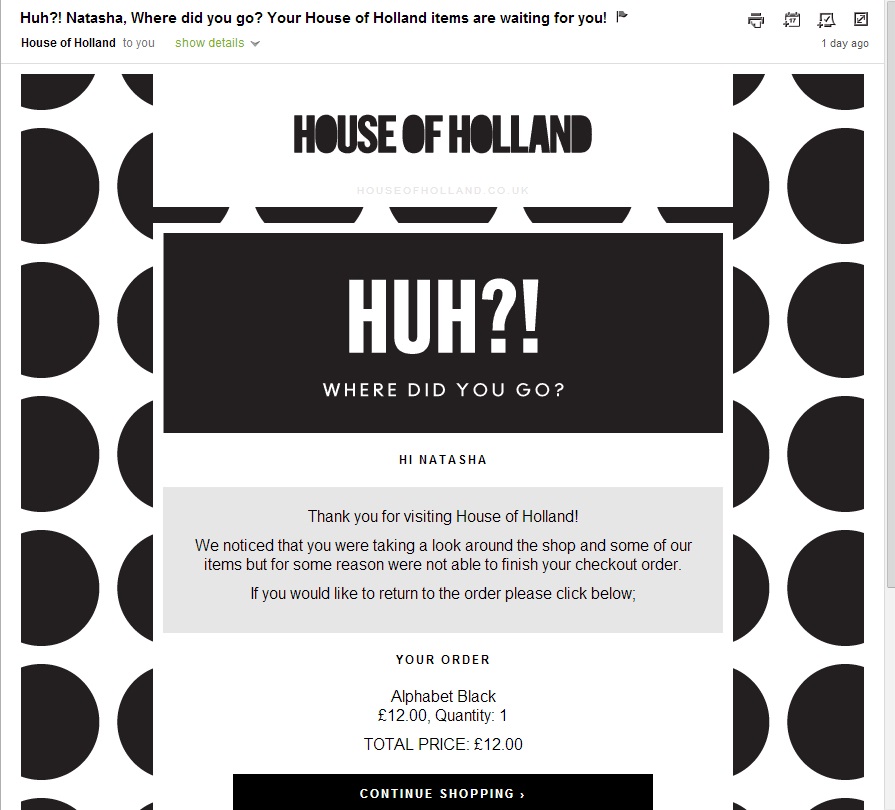
The London fashion brand sent a single, well-designed follow-up to shoppers who left without purchasing — elegant, on-brand, and free of urgency tactics. No countdown timers, no manufactured scarcity. Just a quiet reminder that the item was still there. That restraint is precisely what made it effective, and memorable.
When recovery becomes pressure
Since 2014, the abandoned cart email has matured into a full industry playbook. Platforms like Klaviyo, Omnisend, and Salesforce Marketing Cloud offer automated multi-touch sequences: a first email within an hour, a follow-up the next day, a third with a discount offer by day three. Open this email, and there is a good chance the subject line reads something like “You left something behind” or “Still thinking it over?” Conversion-focused, time-pressured, occasionally guilt-adjacent.
The conventional wisdom in ecommerce has been that more touchpoints equal more recovered revenue. And the data, on the surface, supports this. Email automation platforms frequently report that cart abandonment sequences drive higher conversion rates than standard promotional emails. Brands see the numbers and double down.
But that framing obscures something important. Higher conversion rates on re-engagement emails tell you how many people who were already interested eventually purchased. They say less about the shoppers who felt pestered, unsubscribed, or quietly formed a negative association with the brand. The metric captures the win without recording the cost.
This matters even more in 2026, when consumer expectations around data use have shifted substantially. Privacy regulations like GDPR in Europe and CCPA in California have raised awareness of how personal data, including email addresses collected mid-checkout, can be used. Some consumers now recognize that submitting an email before completing a purchase creates a data trail. For them, the abandoned cart email signals something less welcome: that a brand treated an incomplete transaction as permission to follow up.
The Smith piece noted, almost as a novelty, that Pinterest users were curating boards of their favorite cart abandonment emails. That cultural moment, of consumers celebrating clever marketing, feels distant now. The relationship between brands and inboxes has grown more fraught.
What hesitation is actually telling you
An abandoned cart is not a failed sale. It is a data point about friction, and the brands that treat it that way build more durable customer relationships than those that treat it as revenue left on the table.
This reframe changes everything about how re-engagement should work. If a shopper abandoned because shipping costs were too high, the most effective email addresses that directly. If they abandoned because they were comparison shopping, a straightforward value reminder serves them better than a countdown timer. If they abandoned because they needed more time, a single, low-pressure email sent after 24 hours respects that without manufacturing urgency.
The 2014 piece pointed at this instinctively, highlighting how the best examples felt personal and brand-appropriate rather than generic. That instinct is the right one. The goal of a re-engagement email should be to reduce a specific friction, not to overwhelm hesitation with enough volume that a purchase happens anyway.
Building re-engagement that holds up in 2026
The core principles from a decade ago still apply, but they require more care in execution. A single, well-timed email remains more effective than a three-part drip sequence for most brands. The message should reflect what the shopper actually put in their cart, not a generic prompt to return. Transparency about why they are receiving the email, because they added an item and didn’t check out, builds more trust than a subject line that pretends to be a casual reminder.
Discount offers, which the original article also flagged as high-performing, carry their own trade-off. They recover the sale, but they also train shoppers to abandon carts deliberately, waiting for the inevitable coupon. Research from Harvard Business Review has documented how discount-dependent retention erodes margin and conditions price-sensitive behavior over time. Brands that rely on them heavily can find themselves locked into a cycle that is expensive to exit.
What the best abandoned cart strategies share, whether 10 years ago or today, is a respect for the customer’s actual decision-making process.
Shoppers are not passive targets waiting to be converted. They are people in the middle of a choice. The brands that treat re-engagement as a service, helping someone finish something they may genuinely have wanted to complete, will always outperform those that treat it as a numbers game.