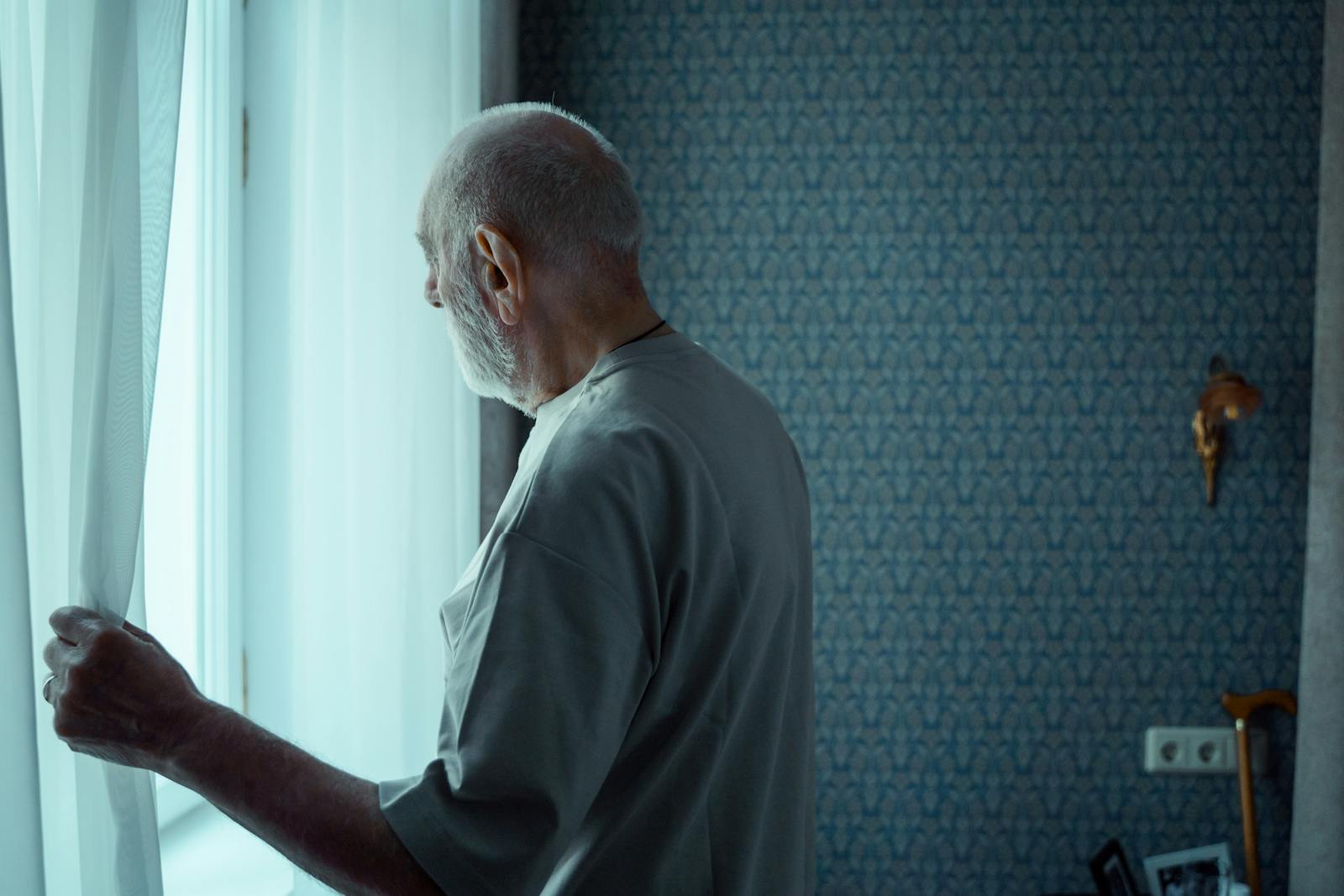
- Tension: The feeling of invisibility in digital spaces isn’t imposed from outside — it emerges from the collision between a settled sense of self and platforms that reward perpetual reinvention.
- Noise: We’ve blamed algorithms and ageist tech bros, when the real issue is a design philosophy that treats identity as a performance requiring constant updates.
- Direct Message: Refusing to perform isn’t disappearing — it’s the quiet assertion that you no longer need an audience to know who you are.
To learn more about our editorial approach, explore The Direct Message methodology.
There’s a particular kind of silence that settles over a person when they realize they’ve stopped being seen. Not invisible in the literal sense — people still respond to emails, still recognize faces at the grocery store. But invisible in the way that matters now: the digital way.
The feeds move on. The notifications slow to a trickle. The likes that once accumulated now arrive sporadically, like late guests at a party that ended hours ago.
For millions of adults over fifty, this experience has become so common it barely registers as strange anymore. They assume it’s the algorithm. They assume it’s ageism. They assume, perhaps, that the young have simply decided to look elsewhere.
But in my three decades working with students and later with adults navigating life’s transitions, I’ve noticed something far more interesting happening beneath the surface. The invisibility isn’t being imposed. It’s being chosen — often unconsciously, sometimes with great relief.
The Exhausting Architecture of Digital Selfhood
The sociologist Erving Goffman published his landmark work on self-presentation in 1959, arguing that social life operates like theater. We all perform, he suggested, managing impressions through front-stage behavior while reserving our authentic selves for backstage moments with trusted intimates. What Goffman couldn’t have anticipated was a world where the front stage would become permanent, where the backstage would shrink to near-nonexistence, and where the performance would need to be updated hourly to maintain relevance.
Social media platforms aren’t neutral spaces for connection. They’re architectures built around a very specific model of identity — one that assumes the self is always in flux, always available for display, always hungry for validation. The currency of these spaces is novelty. Post the same type of content repeatedly and watch engagement evaporate. Share the same opinions you held last year and risk seeming stale. The person who thrives online is the person willing to perpetually reinvent, to curate not just what they show but who they are in increasingly granular intervals.
Research confirms what many feel intuitively. Studies have found that social media platforms function differently for older adults than for younger users, not because the technology discriminates but because the fundamental value proposition changes when peer engagement is lower and the pressure to perform feels increasingly disconnected from lived experience. For younger people still in the identity-formation phase of development, the constant demand for self-presentation aligns with a genuine developmental task. They’re supposed to be trying on identities, seeking feedback, adjusting. For someone who spent decades arriving at a stable sense of who they are, the same demand feels not invigorating but invasive — even exhausting.
The Myth of Algorithmic Exile
When people over fifty notice their declining visibility online, the explanation that springs most readily to mind involves shadowy forces beyond their control. The algorithm, they assume, has decided they’re not valuable. Tech companies, built by and for the young, have simply coded older users out of relevance. There’s a satisfying simplicity to this narrative. It transforms a complex cultural phenomenon into a clear villain with a clear motive.
But this story, however comforting its clarity, obscures what’s actually happening. Algorithms don’t suppress older users so much as they reflect engagement patterns back at us in amplified form. When someone posts less frequently, engages less enthusiastically, or generates less interaction from their network, the algorithm responds by showing their content to fewer people. This isn’t ageism coded into software. It’s the mathematical consequence of designing systems that optimize for attention and activity.
The digital echo chamber operates on a simple principle: it amplifies whatever generates the most engagement and quietly sidelines everything else. The voices that rise to the top aren’t necessarily the most insightful or valuable — they’re the ones willing to play the game most persistently, to feed the machine with the constant stream of content it requires. Research on social media self-presentation has consistently found that maintaining an active online presence demands significant psychological resources, including the ongoing work of managing impressions across multiple audiences who might be watching at any moment. Younger users, still in the process of building social capital and professional networks, often find this investment worthwhile. Older users, having already established their identities and relationships through decades of in-person interaction, increasingly question whether the return justifies the cost.
The echo chamber doesn’t silence older voices through malice. It simply privileges a kind of participation that many older adults find unsustainable, uninteresting, or fundamentally at odds with who they’ve become.
The Liberation Hidden in Withdrawal
The paradox of digital invisibility is this: what looks like being pushed out is often the experience of walking away. And walking away from a performance you never needed to give isn’t loss — it’s freedom.
Reclaiming the Backstage
What I’ve observed in people navigating the second half of life is a gradual but unmistakable shift in priorities. The hunger for external validation that drives so much social media participation begins to loosen its grip. The need to be seen by everyone gives way to a preference for being known by a few. The endless performance of self-presentation starts to feel not just tiring but somehow false — a betrayal of the hard-won authenticity that comes from decades of learning who you actually are.
This isn’t decline. It’s development. Psychological research on adult development has long recognized that the second half of life involves different tasks than the first. Where youth is properly concerned with building identity, establishing oneself in the world, and accumulating social connections, maturity brings a natural turn toward depth over breadth, toward meaning over achievement, toward being over doing. The platforms that dominate our digital landscape were designed by young people in the first flush of identity construction. They embedded their developmental priorities into the very architecture of the tools they built. No wonder those tools feel increasingly ill-fitted to people whose developmental tasks have moved on.
In my years as a guidance counselor and later as a life coach, I watched this pattern repeat across countless lives. The adults who thrived weren’t the ones who fought against the natural arc of development, desperately clinging to the concerns of their younger selves. They were the ones who recognized when a particular stage had ended, who could let go of games that no longer served them, who understood that presence means something different than visibility.
The people I work with now, many of them navigating retirement or the loss of professional identity that comes with leaving careers, often describe a strange relief in their digital absence. They thought they would miss the validation. Instead, they discover they’ve been freed from a constant low-grade anxiety they didn’t even know they were carrying. The backstage, that private space Goffman identified as the place where we can finally stop performing, expands to fill more of their lives. And in that expansion, something unexpected happens: they begin to feel more like themselves than they have in years.
This doesn’t mean abandoning technology or retreating into isolation. Many older adults find digital tools genuinely useful for maintaining connections across distance, accessing information, and engaging in communities built around shared interests rather than shared performance. The difference lies in the relationship. Using technology as a tool for connection is categorically different from submitting to platforms that demand constant self-display as the price of participation.
The direct message for anyone feeling invisible in digital spaces isn’t to try harder, post more frequently, or learn the latest trends in hopes of gaming an algorithm built on assumptions about identity that may not apply to you. The message is simpler and more radical: you are allowed to decline the performance. You are allowed to value being known over being seen. You are allowed to recognize that the invisibility you’re experiencing in digital spaces might be the outward sign of an inward freedom — the freedom of no longer needing an audience to know who you are.
The stages we inhabit change across a lifetime. The roles we play shift and deepen. And eventually, if we’re lucky, we learn that the most important audience for the performance of our lives isn’t the crowd of strangers scrolling past — it’s the person we see in the mirror, and the few people close enough to see us when the curtain finally comes down.